
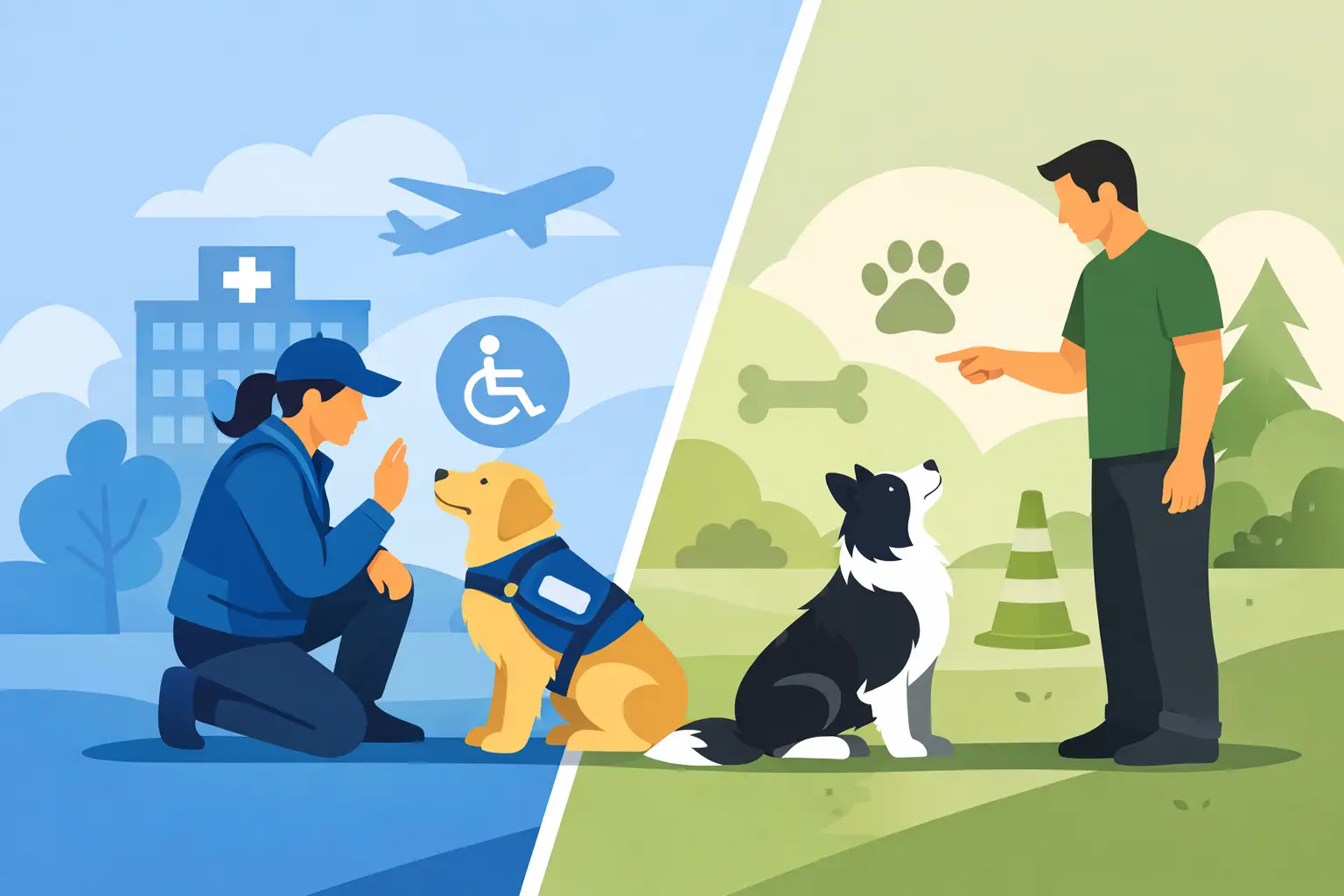
A dog can hold a steady sit at a busy Los Angeles coffee shop and still not be ready for service work. That distinction is the heart of service dog training vs obedience. Obedience creates a well-mannered companion who responds reliably in everyday life. Service dog training builds on that foundation with disability-related tasks, public-access behavior, and the ability to work calmly under real pressure.
For owners, understanding the difference prevents wasted time, unrealistic expectations, and unfair demands on the dog. A trained dog is a happy dog, but the right training plan depends on what the dog is being asked to do.
What obedience training is designed to do
Obedience training teaches a dog how to live successfully with people. The focus is practical: coming when called, walking without pulling, staying in place, settling when guests arrive, leaving dropped food alone, and responding around common distractions.
For a family dog, these skills can change daily life. A reliable recall makes outings safer. A solid place command can stop chaos at the front door. Loose-leash walking turns a stressful neighborhood walk into something enjoyable. For busy owners, the biggest benefit is predictability. You know what your dog will do because your dog understands what is expected.
Good obedience training is not about making a dog robotic or suppressing its personality. It uses clear communication, consistent follow-through, motivation, and appropriate positive reinforcement. The goal is a responsive dog that can relax at home, behave in public pet-friendly settings, and fit smoothly into the household routine.
Obedience also addresses many issues owners mistake for a lack of intelligence: jumping, barking for attention, ignoring commands, counter surfing, door rushing, and leash reactivity. These behaviors often improve when the dog has structure, a clear routine, and commands that have been practiced in the situations where they matter.
What makes service dog training different
Service dog training has a specific purpose: preparing a dog to perform trained tasks that directly assist a person with a disability. The task is the key difference. A dog that provides comfort simply by being present may be deeply valuable, but comfort alone does not make a dog a service dog.
Depending on the handler’s needs, trained tasks may include retrieving medication, alerting to a medical change, interrupting repetitive behaviors, guiding a handler away from an overwhelming situation, opening or closing doors, providing mobility support when appropriate, or responding to a trained cue during a psychiatric episode. The task must be purposeful, reliable, and connected to the handler’s disability.
The dog must also demonstrate exceptional public behavior. Service work can involve crowded sidewalks, elevators, medical offices, restaurants, public transportation, children, carts, unusual noises, and people who do not understand they should not distract a working dog. A service dog needs to remain under control, ignore food and attention, settle quietly for extended periods, and recover quickly from unexpected events.
That is a much higher standard than basic obedience. It is not enough for a dog to perform a command once in a quiet training room. The dog must perform it consistently, in varied environments, while remaining emotionally stable and focused on its handler.
Service dog training vs obedience: the practical differences
Obedience is the foundation. Service work is a specialized job built on top of that foundation. A dog cannot reliably perform advanced tasks in public if it struggles to walk on leash, settle, follow direction, or stay composed around distractions.
The goals are different as well. Obedience training improves life for the dog and household. Service dog training is designed to mitigate the effects of a disability through specific trained behavior. One creates a manageable companion; the other prepares a dog for a demanding working role.
The training environment also changes. Obedience may begin at home and expand to walks, parks, and pet-friendly stores. Service work requires carefully planned exposure to the environments the handler actually uses. Training must account for duration, distractions, access challenges, and the dog’s ability to remain calm without constant rewards or correction.
Finally, the level of evaluation is different. A dog may be obedient and still be unsuited for service work due to anxiety, noise sensitivity, reactivity, poor recovery after surprises, health limitations, or a lack of interest in task work. That is not a failure. It simply means the dog may be better suited to being an excellent pet.
Not every well-trained dog should become a service dog
Service dogs need more than commands. They need the right temperament, sound health, confidence, and resilience. The work asks a lot of them, often for long periods in unpredictable places.
A strong candidate is typically people-neutral rather than overly social, environmentally stable without being shut down, responsive to training, and able to recover quickly if something unexpected happens. Dogs that are fearful, reactive, highly distractible, aggressive, or stressed by busy settings should not be pushed into public-access work. Forcing an unsuitable dog into that role can increase anxiety and create safety concerns for the handler and public.
Age matters, too. Puppies can begin with socialization, engagement, housebreaking, basic manners, and confidence-building. But young dogs are still developing. Their temperament and physical soundness should be assessed over time before anyone assumes they will be ready for the demands of service work.
Breed can influence the conversation, especially for physically demanding tasks, but breed alone does not determine suitability. Individual temperament, health, and trainability matter more than a label. A professional evaluation gives owners a more realistic picture than online quizzes or promises of fast certification.
Beware of shortcuts and certificates
Owners often encounter websites that offer service dog certificates, registration cards, or vests with little or no training involved. These items do not teach a dog to perform tasks or behave appropriately in public. They also do not solve the real challenge: whether the dog can safely and reliably work beside a handler.
A vest does not replace obedience. A registration number does not replace task training. And a dog who barks, lunges, eliminates indoors, steals food, or cannot settle in public is not ready for service-dog expectations, regardless of the paperwork attached to the collar.
For many families, investing first in proven obedience training is the most productive move. It improves life immediately and gives a trainer the chance to assess whether advanced service work is realistic. If a dog is not a candidate, the obedience skills still deliver meaningful results every day.
How to choose the right training path
Start with the actual outcome you need. If your goal is a dog that listens at home, walks politely, greets guests calmly, and behaves during daily outings, obedience training is likely the right place to begin. This is true for most dogs, including puppies, rescues, and dogs whose habits have become difficult to manage.
If you need a dog to perform specific disability-related tasks, begin with an honest evaluation of both the dog and the intended work. Ask whether the dog has the temperament and health for public settings, whether the desired task can be trained clearly, and whether you have the time and consistency to maintain training over the long term.
Service-dog preparation is not a quick course or a single milestone. It is an ongoing partnership. Handlers must practice skills, protect the dog from unnecessary stress, maintain its obedience, and recognize when the dog needs rest or retirement from work.
At Smart Dogs, the training process starts with the dog in front of us, not a one-size-fits-all promise. Clear obedience, motivation-based methods, and real-world practice create the kind of dependable behavior owners can use every day. When specialized service work is appropriate, that strong foundation gives the dog and handler the best possible starting point.
The right training should make life calmer, safer, and more manageable for both of you. Whether your dog’s role is trusted family companion or carefully prepared service partner, build the skills that let your dog succeed with confidence.
