
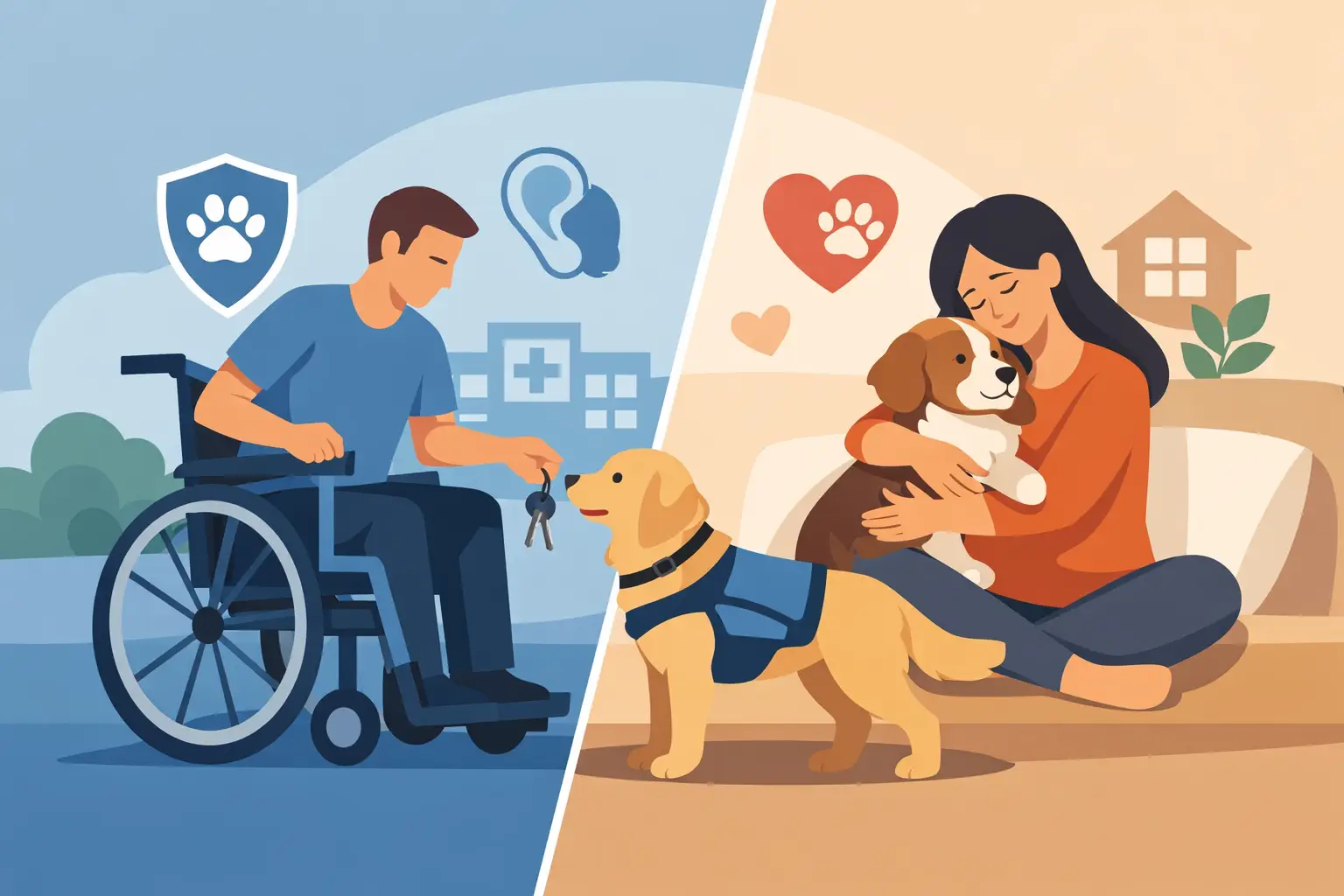
A dog that settles a racing mind after a hard day can be deeply comforting. But when people discuss service dog tasks versus emotional support, they often place two very different roles in the same category. That confusion can lead owners to choose the wrong training path, make inaccurate assumptions about public access, or put unfair pressure on a dog that is simply not suited to the work.
The practical difference comes down to trained, disability-related work. A service dog is trained to perform specific tasks that reduce the effects of a person’s disability. An emotional support animal provides comfort through companionship and presence. Both relationships can be meaningful. They are not, however, interchangeable.
Service Dog Tasks Versus Emotional Support: The Core Difference
Under the Americans with Disabilities Act, a service dog is a dog individually trained to do work or perform tasks for a person with a disability. The task must be directly related to that person’s disability. The dog is not working simply because it makes its owner feel better, keeps them company, or has a calming personality.
For example, a dog trained to retrieve medication, alert a handler to an oncoming seizure, guide a person with low vision around obstacles, or interrupt escalating panic behaviors is performing a service dog task. The training creates a reliable, observable response to a real need.
Emotional support is different. An emotional support animal may help someone feel calmer, less isolated, or more secure through its companionship. That support is real, but comfort from an animal’s presence is not a trained task under the ADA. A friendly dog that naturally cuddles during stressful moments may be a wonderful companion without being a service dog.
This distinction is not about ranking one dog’s value above another. It is about accurately matching the dog, the owner’s needs, and the training expectations. A trained dog is a happy dog when it understands its job, its boundaries, and how to succeed in the environments it enters.
What Counts as a Service Dog Task?
Service work is highly individual. Two people with the same diagnosis may need different forms of assistance, while two dogs may perform the same broad task in different ways. What matters is that the behavior is intentionally trained and mitigates a disability-related limitation.
Mobility-related tasks can include retrieving dropped items, opening or closing accessible doors, providing balance assistance when appropriate, carrying needed items, or helping a handler move to a safe place. Medical alert and response work may include alerting to changes associated with seizures, blood sugar shifts, or other medical events, then retrieving help or a phone as trained.
Psychiatric service dogs can also perform trained tasks. A dog may interrupt repetitive or self-harming behaviors, wake a handler from a nightmare, conduct a room check when that task is clinically appropriate, guide a disoriented handler to an exit, or create space in a crowd on cue. A dog that notices distress and offers affection on its own is comforting. A dog trained to recognize a pattern and perform a specific response is working.
Reliable performance matters as much as the task itself. The dog needs to respond around distractions, in unfamiliar locations, and during the handler’s actual moments of need. That requires more than teaching a trick in a quiet living room. It requires clear criteria, careful proofing, thoughtful exposure, and an honest assessment of the dog’s temperament.
Emotional Support Animals Have a Different, Valuable Role
Many pet dogs provide emotional support without formal task training. Their routines encourage owners to get outside, maintain daily structure, and stay connected. Their presence can reduce loneliness and create a sense of comfort at home. For many families, that is exactly the right role.
An emotional support animal does not automatically have the same public-access rights as a service dog. Rules can vary depending on the setting and the applicable law. Housing protections and travel policies are separate issues from ADA public access, and they can change over time. Owners should verify current requirements with the housing provider, airline, or qualified legal resource rather than relying on social media advice or a purchased online certificate.
A vest, ID card, registration, or letter does not train a dog to perform service work. It also does not replace calm behavior, obedience, or responsible handling. The best foundation for any support animal is still the same: housebreaking, leash skills, impulse control, a dependable recall, and the ability to settle quietly around normal household activity.
Why Temperament and Obedience Come First
Not every well-loved dog should become a service dog. Service work asks a dog to remain composed in busy stores, medical offices, elevators, crowded sidewalks, restaurants, and other unpredictable spaces. The dog may encounter loud sounds, children, food, other animals, mobility equipment, and strangers who do not understand working-dog boundaries.
A suitable candidate generally needs confidence without overexcitement, social neutrality, strong recovery after surprises, and a genuine willingness to work with its handler. A dog that is fearful, reactive, easily overwhelmed, or unable to settle may need behavior support and a calmer lifestyle instead of public-access training. Pushing that dog into demanding environments is not fair to the dog or safe for the people around it.
Obedience is not a cosmetic extra. It is what allows a task-trained dog to do its job without creating new problems. Loose-leash walking, place, down-stay, polite greetings, leave it, and calm settling are practical skills that protect the handler’s independence. They also make everyday life less stressful.
At Smart Dogs, this is why training starts with the dog in front of us, not a label. A proven training plan considers temperament, home routines, the owner’s goals, and the real environments where the dog must perform. Task training only works when the dog has the stability and foundational skills to support it.
Public Behavior Is Part of the Job
Service dogs are working dogs, but they are still dogs. They need exercise, downtime, consistent handling, veterinary care, and opportunities to relax off duty. Even a highly trained dog can have an off day. Responsible handlers recognize when a dog needs a break instead of expecting constant performance.
In public, a service dog should remain under control and be housebroken. The dog should not roam, repeatedly bark, lunge, solicit attention, jump on people, or investigate every floor and food display. A dog does not need to be invisible, but it should be able to work quietly without disrupting the space.
Businesses generally may ask only whether the dog is required because of a disability and what work or task the dog has been trained to perform. They cannot demand medical records, require a special vest, or ask the handler to demonstrate the task. At the same time, a business may address a dog that is out of control or not housebroken. Clear rules protect legitimate handlers, businesses, and dogs alike.
Choosing the Right Path for Your Dog
If your dog’s companionship helps your emotional well-being, begin by building a stable, enjoyable pet dog. Focus on everyday obedience and behavior that makes home life calmer: greeting guests politely, walking without pulling, settling while you work, and responding when called. Those skills improve the relationship without placing service-dog expectations on your dog.
If you believe a service dog may be needed, start with a professional evaluation and a clear description of the functional challenges you want the dog to help address. The question is not, “Can my dog wear a vest?” It is, “Can this dog reliably perform a specific task that helps me function more independently?”
Be prepared for the trade-off: true service-dog training takes time, repetition, money, and ongoing maintenance. Some dogs may have the desire to work but not the public confidence. Others may be excellent family companions yet lack the consistency required for disability-related tasks. There is no failure in recognizing the right role for the dog you have.
The goal is not to give a dog the most impressive title. The goal is a well-trained partner whose behavior brings more steadiness to daily life. Whether your dog is a cherished emotional support animal or a task-trained service dog, clear training, realistic expectations, and respect for the dog’s limits create the strongest possible partnership.
