
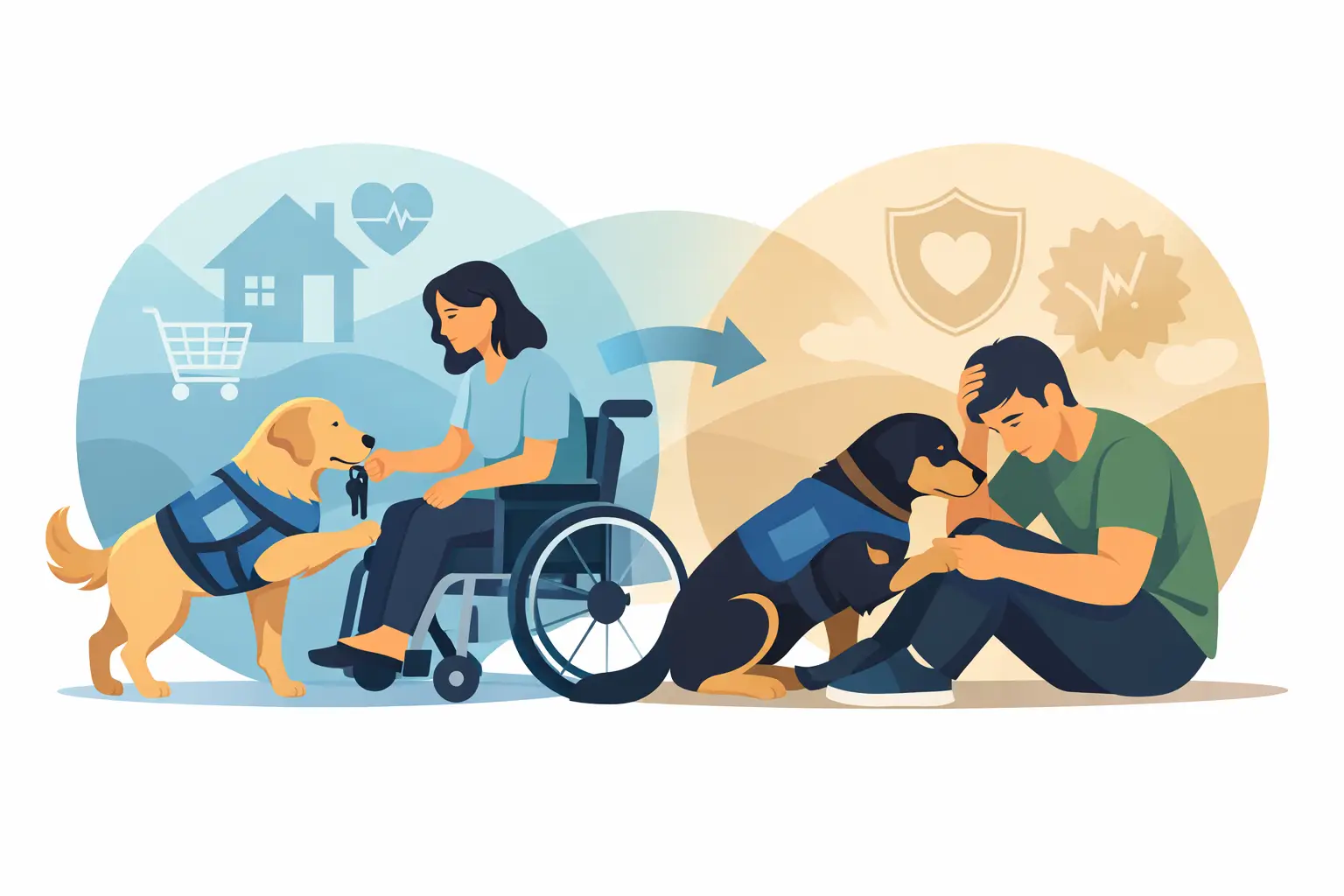
A service dog is not simply a well-behaved dog that makes someone feel better in public. The service dog task examples that matter most are trained, repeatable actions that directly help a person manage a disability. When a task works reliably at home, on a busy sidewalk, or during a stressful medical event, it can create more independence and less daily uncertainty.
That distinction matters for owners, families, businesses, and anyone considering service dog training. A calm dog with solid obedience is a valuable companion. A service dog must go further: it needs the temperament, focus, and specialized skills to perform meaningful work when it is needed.
What Counts as a Service Dog Task?
A task is a specific behavior trained to reduce the effects of an individual’s disability. The dog may retrieve an item, provide physical support, interrupt a harmful behavior, alert to a medical change, or guide its handler away from a difficult situation. The work must be directly connected to the person’s needs.
Comfort alone is not a task. A dog’s presence can be deeply reassuring, but emotional support by itself does not make a dog a service dog. For example, a dog that lies quietly beside a handler during anxiety may be comforting. A dog trained to recognize escalating anxiety, interrupt repetitive self-harm, and guide the handler to an exit is performing trained disability-related work.
The best task is not the most impressive one. It is the one that solves a real problem consistently and safely.
Service Dog Task Examples by Need
Every service dog program should begin with the handler’s real daily challenges. A task that is useful for one person may be unnecessary or unsafe for another. The dog’s size, physical structure, age, temperament, and training history also affect what work is appropriate.
Mobility and retrieval tasks
Mobility service dogs may help a handler access objects, maintain balance, or complete daily routines with less physical strain. Common tasks include retrieving dropped keys or a phone, bringing medication, opening accessible doors, operating light switches, pulling off socks, and picking up items from the floor.
Some dogs are trained to provide carefully designed balance support or forward momentum. This work requires more than obedience. The dog must be physically suited to the task, professionally conditioned, and able to maintain position without being startled by crowds, uneven ground, or sudden movement. Using a dog for bracing or balance without appropriate assessment can place both the handler and dog at risk.
Medical alert and response tasks
Medical service dogs can be trained to alert or respond to certain health events. Depending on the handler’s needs and the dog’s demonstrated ability, tasks may include alerting to changes associated with diabetes, responding to a seizure, fetching a phone, getting another person, bringing emergency supplies, or activating an alert system.
A response task is often easier to define and train than an alert task. For instance, a dog can learn that when a handler becomes unresponsive, it should retrieve a medical kit or seek help from a designated person. Medical alerts, especially those involving scent or subtle behavior changes, require careful training, testing, and honest expectations. Not every dog can perform this work, and no service dog should replace medical care or an emergency plan.
Psychiatric service dog tasks
Psychiatric service dogs perform trained actions that help people with conditions such as PTSD, panic disorders, severe anxiety, or other psychiatric disabilities. Their work is active and purposeful, not simply companionship.
A dog may interrupt repetitive or harmful behavior by nudging, pawing, or placing its head in the handler’s lap on cue or in response to a trained signal. It may wake a handler from a nightmare, create space in a crowd by standing in a trained position, remind the handler to take medication, conduct a room check, or guide the handler toward an exit during a panic episode.
The goal is not to make a dog hypervigilant or anxious about its handler. A well-trained psychiatric service dog stays composed, performs the task, and returns to a calm working state. That emotional steadiness is just as important as the task itself.
Hearing and vision assistance tasks
Hearing dogs can alert their handlers to meaningful sounds, such as a smoke alarm, doorbell, crying child, timer, or a person calling their name. The alert must be clear and followed by a trained action, often leading the handler toward or away from the sound source.
Guide dogs for people who are blind or have low vision perform highly specialized work. Tasks can include stopping at curbs and stairs, avoiding obstacles, finding doors, locating specific destinations, and refusing a command when following it would put the handler in danger. This advanced training has a very high standard because the handler’s safety depends on sound judgment from the dog.
Tasks Are Different From Obedience Commands
Sit, down, stay, heel, and come are essential skills, but they are not service dog tasks on their own. They create the control needed for service work. A dog cannot reliably retrieve medication in a hospital waiting room, guide a handler through a crowd, or respond during a panic episode if it is distracted, fearful, pull-focused, or unable to settle.
That is why a proven training system starts with foundation work. The dog needs house manners, leash skills, impulse control, confidence around people and environments, and reliable responses to commands. A trained dog is a happy dog, but a service dog also needs the ability to work under real-life pressure.
Public access behavior is part of that standard. A working dog should move through stores, medical offices, restaurants, elevators, and other appropriate public settings without barking, lunging, scavenging, soliciting attention, or interfering with others. Even an excellent task does not make up for poor behavior in public.
Choosing the Right Tasks for Your Dog and Lifestyle
Start with a simple question: what specific moment in the day is hardest or least safe without assistance? The answer should lead the training plan. “I want my dog to help with anxiety” is broad. “I need my dog to interrupt skin-picking when I dissociate and guide me to sit in a quiet area” gives a trainer something clear to evaluate and build.
A practical plan also considers the dog. A small dog may be excellent at medication retrieval, sound alerts, and psychiatric interruption, while not being appropriate for mobility support. A large, steady dog may be able to retrieve heavier items or work beside a wheelchair, but size alone does not guarantee suitability. Good service work depends on temperament, health, motivation, and dependable training.
Owners should be cautious about shortcuts. Online registrations, vests, identification cards, and certificates do not teach a dog to perform tasks. They also do not prove that a dog can behave safely in public. The real measure is performance: Does the dog complete a trained task when needed, and can it remain under control around everyday distractions?
How Reliable Service Tasks Are Built
Reliable tasks are built in layers. First, the dog learns the behavior in a quiet, familiar environment. Then the trainer adds distance, duration, and distractions. Finally, the dog practices in the places and situations where the handler will actually need help.
For example, teaching a dog to retrieve a phone begins with a clear hold and delivery. The next steps may include finding the phone in another room, retrieving it when the handler is seated or on the floor, and responding when there is noise, visitors, or other distractions. The dog is rewarded for accuracy, not rushed through the process.
At Smart Dogs, the focus is always on practical outcomes. Positive reinforcement and motivation-based training can build eager, clear responses, while structure teaches the dog that work has rules. The process should never be about making a dog look impressive for a video. It should create reliable help for everyday life.
A service dog’s job may look simple from the outside: pick up a phone, nudge a hand, lead someone to a door. But when that action happens at the right moment, with a calm and willing dog, it can change how safely and confidently a person moves through the day. Start with the need, train the task with purpose, and give the dog the foundation to succeed.
