
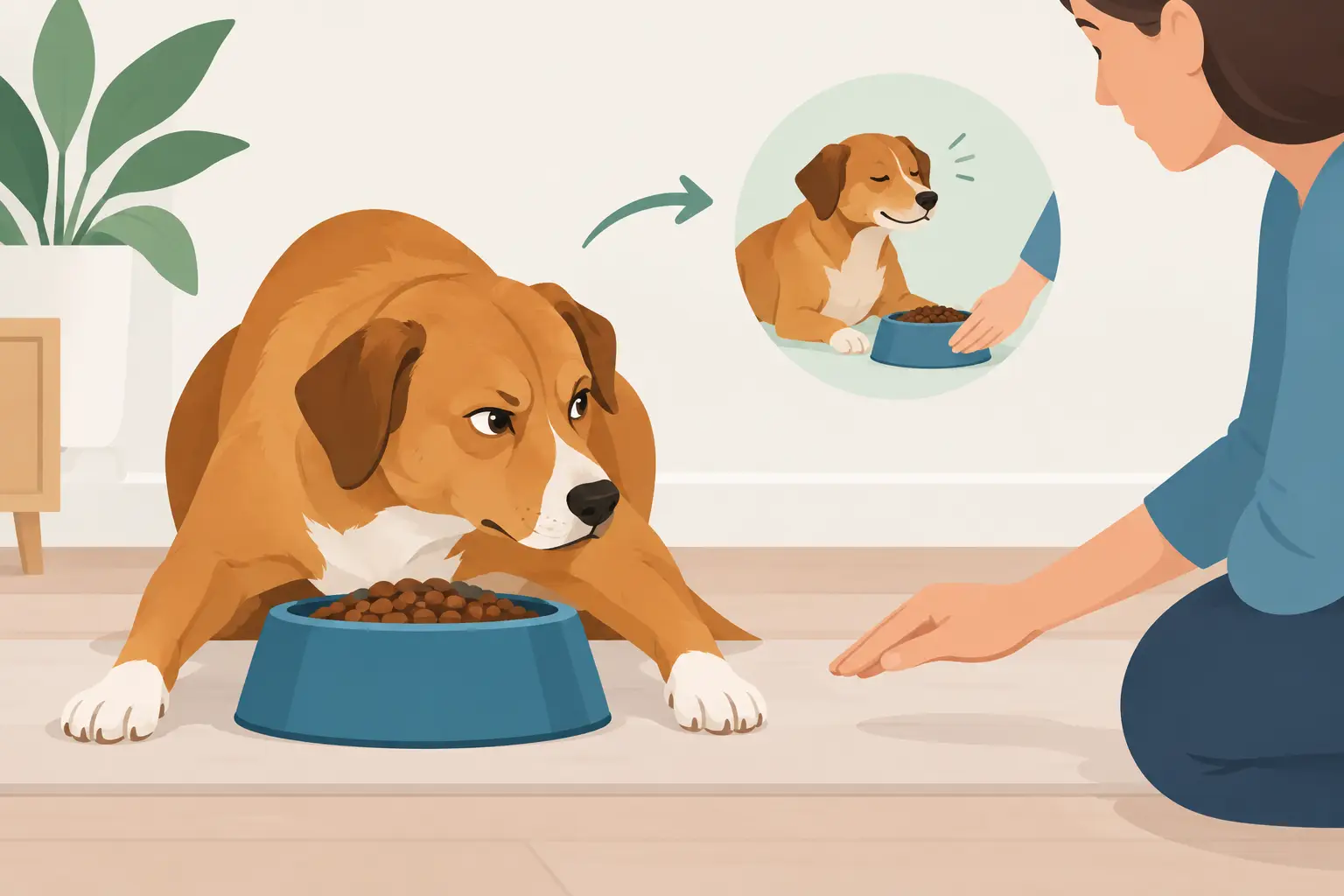
A dog may look perfectly sweet all day, then stiffen, growl, or snap when someone walks near the food bowl. That contrast is upsetting, especially in a busy home with children, visitors, or more than one pet. Understanding why dogs guard food is the first step toward changing the behavior safely. Food guarding is not a sign that your dog is bad, stubborn, or trying to control the household. It is usually a dog communicating that they are worried about losing something valuable.
The goal is not to prove that you can take your dog’s food. The goal is to teach your dog that people approaching the bowl predict good things. With a clear plan, patient practice, and professional help when needed, many dogs can develop calmer, safer mealtime habits.
Why Dogs Guard Food
Food guarding is one form of resource guarding. A resource can be anything a dog considers valuable: meals, treats, chews, toys, a bed, a favorite spot on the couch, or even a person. When a dog guards food, they may freeze over the bowl, eat faster, lower their head, show the whites of their eyes, growl, bare teeth, lunge, or bite.
Those signals are not random. They are distance-increasing behaviors. Your dog is saying, “Please give me space while I have this.” A growl can sound alarming, but it is valuable communication. Punishing the growl may suppress the warning without changing the underlying discomfort, leaving a dog more likely to bite with less notice next time.
Some dogs guard because they had to compete for food early in life. Puppies raised in large litters, dogs from shelters, and dogs with an unknown history may have learned that meals disappear quickly. Other dogs have never experienced scarcity but are naturally more protective of high-value items. Genetics, temperament, stress, household changes, and previous experiences can all play a role.
It can also depend on the item. A dog who is relaxed around regular kibble may guard a bully stick, a stuffed food toy, or leftovers dropped on the kitchen floor. That does not mean the behavior is minor. It means your training plan needs to account for the situations that actually trigger your dog.
A sudden change deserves attention
If a dog who has always been easygoing around food suddenly begins guarding, schedule a veterinary exam. Pain, dental problems, digestive discomfort, medication changes, and other health concerns can lower a dog’s tolerance and make them more defensive. Behavior training works best when medical causes have been considered first.
What Not to Do Around a Guarded Bowl
Well-meaning owners are often told to put a hand in the food bowl, take the bowl away, or make the dog wait while people touch their meal. These exercises can create exactly the problem you are trying to prevent. From your dog’s perspective, a person approaching now reliably means food may be lost.
Do not corner your dog, scold them for growling, grab the bowl, or physically force them away from food. Avoid testing whether the problem is still there. A test can quickly become a bite situation, and each confrontation can make the dog more worried about future meals.
Children should never be asked to participate in food-guarding exercises. Even a friendly family dog needs uninterrupted space while eating. Create household rules that are easy to follow: leave the dog alone at meals, do not reach for chews, and ask an adult for help if something needs to be picked up.
Management is not giving up. It is the responsible first layer of a behavior plan. Feed your dog in a quiet area behind a baby gate, in a crate if they are comfortably crate trained, or in a separate room. Pick up bowls after meals if other pets create tension. Keep high-value chews for times when you can provide true separation and supervision.
A Safer Training Plan for Food Guarding
The most effective approach changes your dog’s emotional response to people nearby. Rather than approaching to remove food, you approach from a safe distance and add something better. Your dog learns that a person arriving is good news.
Before you begin, be honest about risk. A dog who has bitten, lunged, guarded from several feet away, or guards food around children should work with a qualified professional. Do not attempt close-range training on your own. Safety for your family and your dog comes first.
Start farther away than you think
Begin at a distance where your dog can eat comfortably and shows no stiffness, freezing, hard staring, or faster eating. While the dog is eating, walk into view, toss a high-value treat such as chicken or cheese toward the bowl, then walk away. Do not reach toward the bowl. Repeat this in short sessions.
The sequence matters: person appears, bonus treat arrives, person leaves. Over repeated sessions, many dogs begin to look up happily when someone approaches because they expect something better. That is the emotional shift you want.
If your dog stiffens or stops eating, you are too close or moving too quickly. Increase distance immediately. Training should be calm enough that your dog can succeed, not tense enough that they feel compelled to defend themselves.
Gradually change one detail at a time
When your dog remains loose and comfortable, take one small step closer on a later session. Continue tossing the bonus and walking away. Do not progress simply because your dog tolerated one repetition. Look for relaxed body language over multiple sessions.
As the dog improves, you may work toward standing closer, dropping treats directly into the bowl, and eventually briefly touching the bowl only if the dog is genuinely comfortable. There is no prize for taking food away. In most homes, a dog does not need to accept constant handling of their meal. They need to feel safe, and the people around them need a reliable routine.
For dogs that guard chews or stolen items, teach a positive trade. Offer something better, wait for the dog to move away from the item, then pick it up. In everyday life, follow through by sometimes giving the original item back when it is safe to do so. If every trade ends in permanent loss, your dog has a reason to become suspicious.
Build Skills Outside Mealtime
Food-bowl work is only part of the solution. A dog with a strong foundation in obedience is easier to guide through real-life situations. Practice recall, place, leave it, drop it, and a calm wait when there is no conflict over resources. Use rewards your dog values and keep sessions short enough to end successfully.
A reliable “drop it” should not mean “I am going to take your treasure and you get nothing.” It should mean releasing an item leads to a worthwhile reward. Over time, this gives you a practical way to manage dropped food, unsafe objects, and household surprises without turning every interaction into a struggle.
Your daily routine matters too. Dogs often do better when meals, exercise, rest, and training have a predictable rhythm. That does not mean every day must be rigid. It means your dog should not have to guess whether people will invade their space or compete with them for food.
When to Bring in a Professional Trainer
Resource guarding can improve, but it is not a behavior to minimize. Get professional support promptly if your dog has made contact with teeth, guards around a child or another pet, guards multiple objects, or appears tense even when people are across the room. The same is true if you feel nervous feeding your dog. Your safety concerns are enough reason to ask for help.
A skilled trainer can assess the full picture: what triggers the guarding, how intense it is, which family members are involved, and which management setup fits your home. For more serious cases, a trainer may also coordinate with your veterinarian or recommend a veterinary behavior professional. The right plan is tailored to the dog in front of you, not copied from a social media video.
Smart Dogs works with owners on practical household behavior, building reliable communication without creating more stress around the things dogs value most. Proven results come from consistent handling, clear boundaries, and training that helps the dog feel secure rather than challenged.
Your dog does not need to “win” a battle over dinner. They need to learn that mealtime is predictable, people are safe to have nearby, and calm behavior pays off. Protect their space while you build that trust, and you create the kind of peaceful routine that makes life easier for everyone.
