
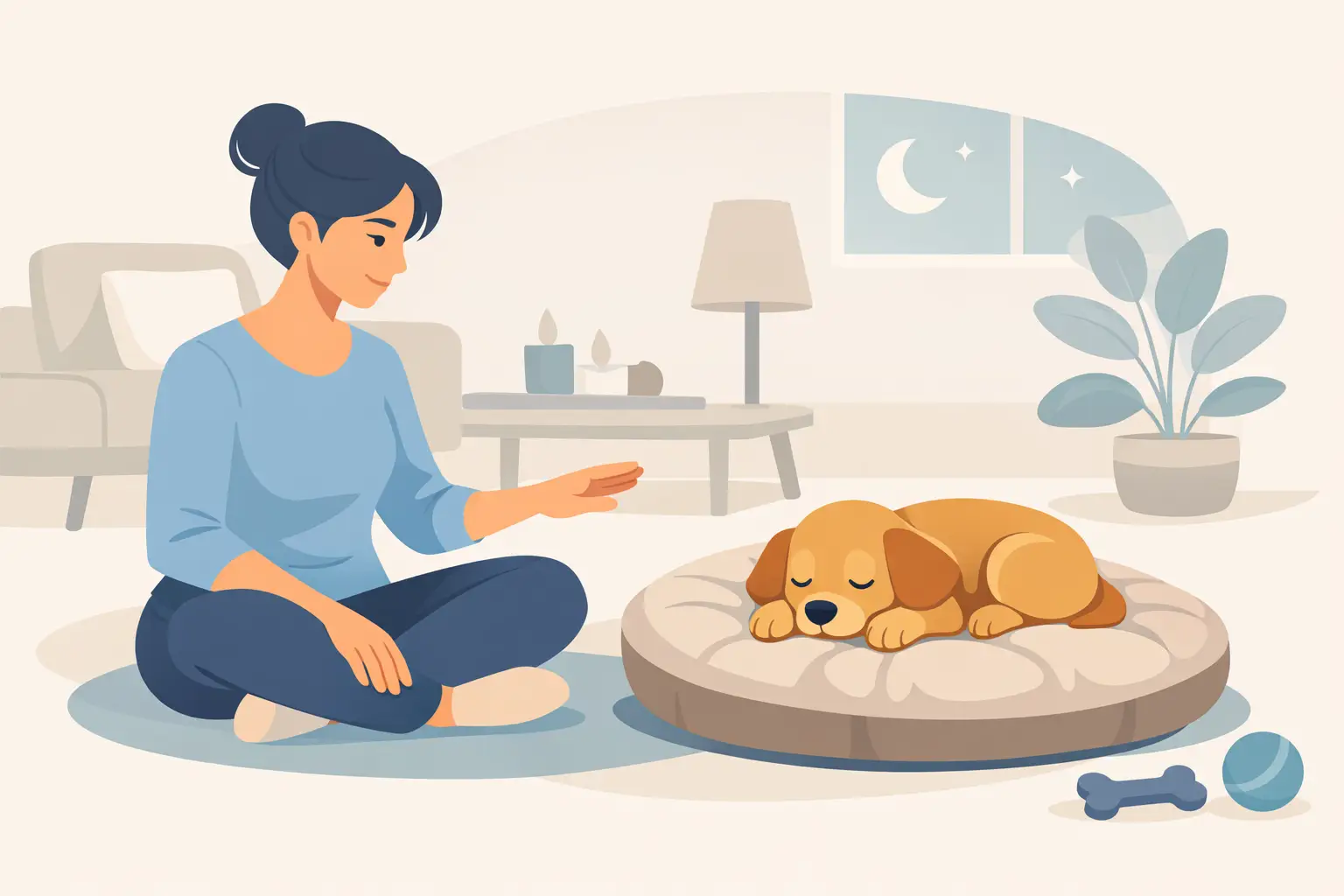
A puppy who races from room to room, mouths the furniture, barks at every hallway sound, or demands constant attention is not necessarily being difficult. Most puppies simply have not learned what calm looks like at home. When you train puppy to settle indoors, you teach an everyday life skill: how to rest while people cook, work, talk, watch television, or answer the door.
This is not about expecting a young dog to be quiet for hours without exercise or interaction. It is about creating a clear routine where your puppy learns that active time has a beginning and an end. That structure reduces stress for the entire household, especially for busy families and apartment dwellers who need their dog to be manageable around everyday distractions.
Why puppies struggle to settle in the house
Puppies are learning how to regulate themselves. They arrive in a new environment full of sights, scents, people, toys, appliances, and sounds, then are often given access to all of it at once. Add inconsistent naps, long bursts of excitement, and accidental rewards for demanding behavior, and it becomes hard for a puppy to switch off.
Overtired puppies are frequently mistaken for high-energy puppies. A puppy that becomes wild in the evening may need a short potty break and a quiet nap more than another game of fetch. Young dogs commonly need far more sleep than owners expect, often 16 to 20 hours across a day. The exact amount depends on age, breed, health, and activity, but regular rest is not optional.
The goal is not to suppress normal puppy behavior. Chewing, exploring, and playing are part of healthy development. The goal is to give those behaviors an appropriate outlet, then clearly show your puppy where and how to relax afterward.
Set up a calm place before asking for calm behavior
A puppy cannot reliably settle in a chaotic environment without help. Start by choosing one consistent resting area. It can be a crate, exercise pen, dog bed, or a mat beside your desk. A crate is useful for many puppies, but it should never be used as punishment. The right choice is the one your puppy can safely use and gradually learn to enjoy.
Make the area simple and predictable. For most puppies, that means a comfortable surface, access to water when appropriate, and a safe chew or food-stuffed toy when supervised. Avoid filling the space with so many exciting toys that it becomes another play zone.
Before each practice session, meet your puppy’s basic needs. A successful settle usually follows a potty break, age-appropriate exercise, a little training or sniffing, and a chance to decompress. If your puppy has been confined for hours or has not been outside, asking for a long down-stay is unlikely to work.
How to train a puppy to settle indoors
Start with a short, repeatable routine
Pick a phrase such as “settle,” “place,” or “bed.” The word matters less than using it consistently. Walk your puppy to the resting area after a potty break or calm activity, say the cue once, and reward any choice to step onto the mat, sit, lie down, or remain there quietly.
At first, reward quickly. If your puppy lies down, calmly place a treat between their front paws. This keeps the reward low and prevents the puppy from popping up to chase your hand. A quiet “good” can add information without building excitement.
Do not wait for perfection before rewarding. A puppy who stays on the bed for three seconds has given you a starting point. Reward that success, then release them before they make a mistake. Short wins build understanding faster than repeatedly asking for more than a young dog can handle.
Reward calm, not just commands
Formal training sessions are helpful, but some of the best settling practice happens when you are not actively training. If your puppy walks over, lies down near your feet, and exhales, quietly reward that choice. If they choose their bed while you make dinner, deliver a treat without turning it into a celebration.
This teaches an important lesson: calm behavior works. Puppies repeat what pays off. If jumping, barking, or pawing always earns eye contact and conversation while quiet resting earns nothing, the puppy will continue demanding attention. Shift that pattern by giving attention, treats, and access to activities when your puppy is composed.
That does not mean ignoring every bid for attention. Puppies need connection and guidance. It means being intentional. Give play, affection, walks, and training on your terms, then make calm behavior rewarding too.
Build duration in small increments
Once your puppy can settle with you nearby, gradually increase the time between rewards. Move from several seconds to 15 seconds, then 30, then a minute. If your puppy gets up, do not scold or repeat the cue over and over. Calmly guide them back, make the next repetition easier, and reward sooner.
Increase only one challenge at a time. You might first add duration while sitting beside the bed. Later, stand up, take one step away, sit at your desk, or move around the room. Asking for 20 minutes of quiet while the family eats dinner, the doorbell rings, and children play is a much harder assignment than settling beside you in a quiet room.
A leash can help during early practice, particularly in an open-plan home. Attach it to your puppy while you are actively supervising, keep enough slack for comfort, and use it to prevent wandering rather than to pull the puppy into position. Never tether a puppy unsupervised.
Use a realistic daily rhythm
A predictable day makes indoor behavior easier. Puppies generally do best with alternating periods of potty breaks, activity, short training, meals, and rest. The schedule does not need to run by the minute, but it should be consistent enough that your puppy learns when excitement is available and when the household is quiet.
For example, after a morning potty break, a brief walk or play session, and breakfast, guide your puppy to their resting area while you begin work. After a nap, take them outside before expecting more indoor freedom. This prevents many housebreaking mistakes and teaches that calm time is a normal part of life, not a consequence for being energetic.
Common mistakes that keep puppies wound up
One common mistake is trying to tire a puppy out with nonstop physical activity. Exercise matters, but more stimulation is not always the answer. A puppy can become physically tired yet mentally over-aroused. Sniffing walks, simple obedience practice, food puzzles, and quiet chewing can be just as valuable as high-speed play.
Another mistake is giving full access to the home too early. Freedom should grow with reliability. If your puppy cannot settle in the living room, use a pen, leash, baby gate, or supervised tethering plan rather than allowing them to rehearse chewing, counter surfing, or racing upstairs. Management is not failure. It prevents unwanted habits while training catches up.
Finally, avoid making the resting space appear only when you need the puppy out of the way. Practice settling at different times of day, including when nothing inconvenient is happening. Your puppy should learn that their bed predicts comfort, good things, and a chance to relax.
When restlessness needs additional support
Some puppies need more individualized help, especially if they panic when separated, cannot settle after reasonable exercise and potty breaks, guard their space or chew items, or react strongly to normal household activity. Sudden changes in restlessness can also be worth discussing with a veterinarian, particularly if pain, digestive upset, or another health concern may be involved.
Professional training can provide a clear plan for your home, schedule, and puppy’s temperament. Smart Dogs uses practical, motivation-based training to help owners build functional commands and calm behavior that carries over into real life.
Your puppy does not need a perfect home or an endless supply of entertainment. They need clear expectations, enough rest, and consistent reinforcement for making good choices. Every quiet minute on the bed is a small investment in the calm, confident companion you want beside you for years to come.
