
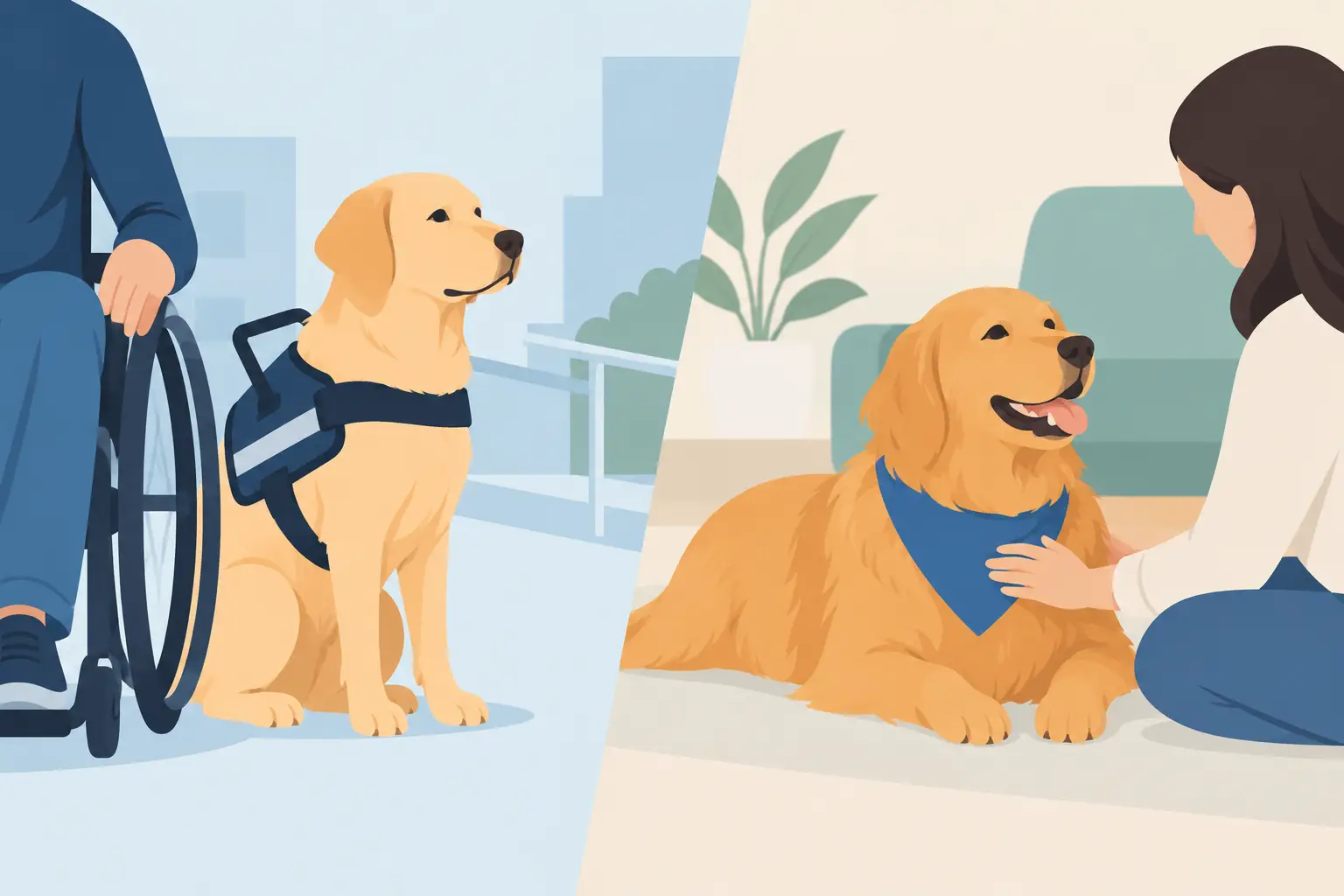
A calm Labrador wearing a vest may look like a working service dog at the grocery store. A gentle Golden Retriever visiting a hospital may look equally professional. But in the service dog versus therapy dog conversation, appearance is not what determines the dog’s role, legal access, or training requirements. The difference comes down to one question: What job has the dog been trained to perform, and for whom?
Getting that answer right protects the public, the people who rely on trained dogs, and the dog itself. It also helps owners set realistic training goals. A friendly dog can be a wonderful companion without being suited for public-access work or therapy visits.
Service Dog Versus Therapy Dog: The Core Difference
A service dog is individually trained to perform specific tasks that help a person with a disability. Under the Americans with Disabilities Act, or ADA, the dog’s trained task must be directly related to that person’s disability. The dog is not simply there for comfort, companionship, or general emotional support. It has a practical, repeatable job.
For example, a service dog may guide a person who is blind, alert a person who is deaf to an alarm, retrieve medication, provide balance support, interrupt self-harming behavior, or alert to changes associated with a medical condition. Psychiatric service dogs can also perform trained tasks, such as interrupting a panic response, waking a handler from a nightmare, or creating space in a crowd on cue.
A therapy dog is trained to provide comfort and positive interaction to other people. These dogs may visit hospitals, schools, senior communities, libraries, or disaster-response settings with their handlers. Their work can be meaningful and valuable, but it is volunteer or program-based work rather than disability assistance for the handler.
Put simply: a service dog works for one person with a disability. A therapy dog works with its handler to support many people.
Public Access Is Not the Same
This is the distinction that causes the most confusion for families and businesses. A trained service dog generally has the right to accompany its handler in public places where pet dogs are not allowed, such as restaurants, stores, hotels, and many workplaces. The dog must remain under control and be housebroken. A service dog that is barking repeatedly, lunging, eliminating indoors, or creating a safety concern can be removed, even if it is a legitimate service dog.
Therapy dogs do not receive broad public-access rights under the ADA. They may enter a hospital, school, or similar location when they have been invited or approved through the organization’s therapy animal program. That permission applies to the visit or facility, not to every restaurant, store, or airplane terminal.
A vest, patch, registration card, or online certificate does not create service-dog status. There is no official federal service-dog registration that an owner must purchase. What matters is whether the handler has a disability and whether the dog is trained to perform disability-related tasks while behaving appropriately in public.
Businesses are allowed to ask limited questions when the need for a service dog is not obvious: whether the dog is required because of a disability and what work or task it has been trained to perform. They cannot demand medical records, request a demonstration, or require the dog to wear identifying gear.
Training Standards and Everyday Expectations
Both types of dogs need training, but the pressure and precision of that training are different.
A therapy dog needs excellent manners around unfamiliar people, including children, older adults, mobility equipment, noises, and unexpected touch. The dog should enjoy calm interaction with strangers and recover quickly from normal distractions. Therapy work is not appropriate for a dog that is fearful, defensive, overstimulated, or uncomfortable being handled by new people.
A service dog needs those manners plus advanced task training and reliable public behavior. The dog must ignore food on the floor, other dogs, carts, crowds, loud sounds, and the many unpredictable events that happen in daily life. It must settle quietly under a table, walk on a loose leash through a busy environment, and respond promptly to its handler even when the handler is stressed or distracted.
That level of reliability is not built through a few obedience classes or a vest. It takes consistent, structured training, careful exposure, and honest evaluation of the dog’s temperament. A trained dog is a happy dog, but only when the training fits the dog’s ability and the job being asked of it.
Can Any Friendly Dog Become a Therapy or Service Dog?
No. Friendly is a good starting point, but it is not enough.
Many dogs love their own family yet become uneasy around wheelchairs, sudden hugs, children running nearby, or strangers reaching over their heads. Others are social and affectionate but too excitable to settle in a hospital hallway or crowded café. A dog can be deeply loved and still be the wrong candidate for therapy work or service work.
The strongest candidates tend to be confident, stable, people-neutral or people-friendly, responsive to training, and able to recover from surprises. They need sound physical health as well. A dog with chronic pain, poor mobility, or significant anxiety should not be asked to carry the demands of a working role.
Age matters too. Puppies can begin foundation work early, including housebreaking, socialization, focus, leash skills, and calm behavior around the world. But their adult temperament is still developing. Rushing a young dog into public work can create stress and expose gaps that are difficult to fix later.
Where Emotional Support Animals Fit In
Emotional support animals are often confused with both service dogs and therapy dogs. An emotional support animal provides comfort through companionship, but it does not need trained tasks related to a disability. It is also not a therapy dog simply because it helps its owner feel better.
Emotional support animals do not have the same general public-access rights as service dogs. Housing rules can be different, and some assistance-animal protections may apply in specific housing situations. Airline and travel policies also vary. Before making plans around housing, travel, or work, check the rules that apply to that provider and your circumstances.
Using the right label is more than a technicality. When untrained pets are presented as service dogs, legitimate working dogs face more challenges in public. It can also put an anxious or reactive dog in situations it cannot handle safely.
How to Choose the Right Path for Your Dog
Start with the outcome you actually need. If you have a disability and need a dog trained to perform specific tasks that increase independence or safety, service-dog training may be appropriate. The process should begin with a candid assessment of the dog, your daily needs, and the tasks that would make a real difference.
If your dog thrives on meeting new people and you want to volunteer in organized settings, therapy-dog preparation may be the better fit. Focus first on dependable obedience, leash control, calm greetings, handling tolerance, and the ability to settle around distractions. Therapy organizations may have their own evaluations, health requirements, and visit policies.
If what you want is a more manageable companion at home and around your neighborhood, basic obedience may be the best and most immediate investment. Reliable recall, loose-leash walking, place, stay, polite greetings, and calm behavior around visitors improve daily life for nearly every dog owner. Not every dog needs a title or working role to become an outstanding family dog.
The Best Role Is the One the Dog Can Perform Well
Service dogs and therapy dogs both make a difference, but they are not interchangeable. One provides trained disability assistance to a specific handler. The other brings comfort to people through approved visits and community programs. Each role asks a great deal of the dog, and each depends on consistent training, sound temperament, and responsible handling.
Before choosing a path, look past the vest and focus on the work. Give your dog the training that supports a calm, confident life – and choose a role that lets both of you succeed.
