
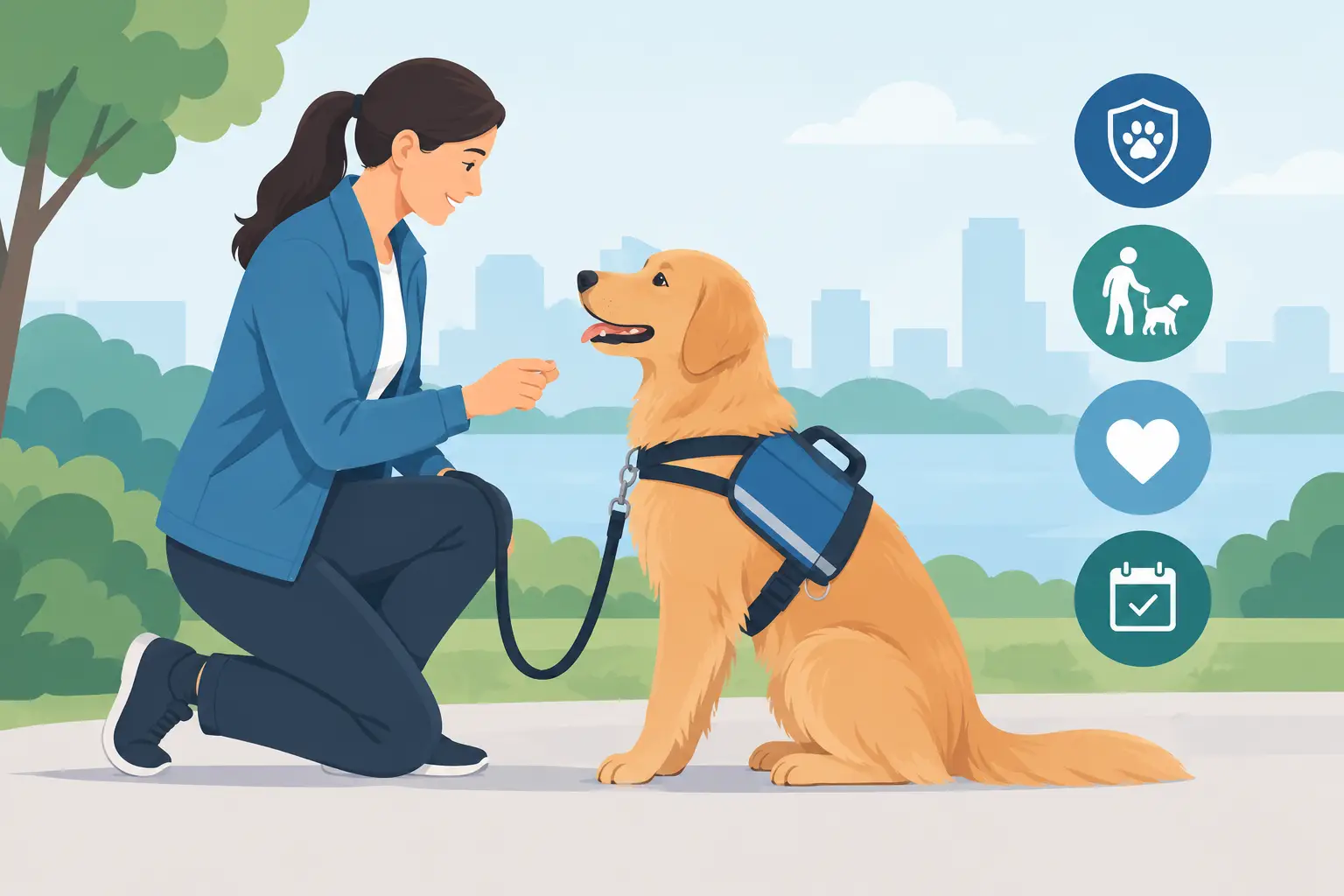
A service dog is not simply a well-behaved dog wearing a vest. A legitimate working dog must perform trained tasks that help mitigate a handler’s disability, while remaining calm, safe, and responsive in the real places life happens. This service dog training guide focuses on the practical work behind that standard: selecting the right candidate, building obedience, teaching meaningful tasks, and preparing the team for daily life.
For Los Angeles owners, that daily life may include elevators, busy sidewalks, apartment hallways, medical appointments, restaurants, traffic noise, and close contact with strangers. The goal is not to create a dog that looks impressive for a few minutes. The goal is a steady partner whose behavior supports the handler without creating stress for the public, the dog, or the household.
Start With the Right Dog, Not Just the Right Intention
Service dog work places unusual demands on a dog. The dog needs sound health, stable nerves, a willingness to work with people, and the ability to recover from surprises. A dog can be loving, intelligent, and highly trained as a pet while still being poorly suited for public-access service work.
Temperament matters more than breed labels. The best prospects are usually confident without being pushy, social without needing attention from everyone, and curious without becoming overstimulated. They can settle quietly, tolerate new environments, and redirect back to their handler when something unexpected happens.
A professional temperament assessment can save a family significant time, expense, and disappointment. Watch for concerns such as fearfulness, reactivity toward dogs or people, noise sensitivity, guarding, chronic anxiety, or an inability to settle. These behaviors do not make a dog “bad.” They do mean service work may not be fair or appropriate for that individual dog.
Health also has to be part of the decision. A working dog needs the physical structure and stamina for the tasks being asked of it. Mobility-related work, for example, requires careful veterinary guidance and thoughtful task design. Asking a young, growing, or physically compromised dog to bear weight can cause harm.
Build Obedience Before Specialized Service Tasks
Reliable service work rests on clear everyday obedience. Before task training becomes the focus, the dog should understand how to move through life under control. That includes coming when called, walking politely on leash, staying in position, leaving distractions, settling on a mat, and responding promptly to the handler’s cues.
These are not cosmetic skills. A solid heel prevents a dog from blocking an aisle or pulling a handler into danger. A dependable down-stay allows the dog to rest quietly beneath a table. Recall and “leave it” can prevent a serious problem when food, another animal, or a sudden distraction appears.
Train these behaviors first in low-distraction settings, then gradually add difficulty. A dog that sits beautifully in a quiet living room has not necessarily learned to sit at a busy park, near a shopping cart, or while people approach. Progress comes from controlled repetition, clear expectations, and rewards the dog genuinely values.
Positive reinforcement and motivation-based training are especially effective when paired with structure. Reward the correct choice, make the expectation understandable, and avoid moving faster than the dog can handle. Consistency matters more than marathon sessions. Five focused minutes practiced correctly can accomplish more than a long session where the dog is tired, confused, or overwhelmed.
Teach the Handler, Too
A service dog team includes two learners. Handlers need to give cues consistently, recognize early signs of stress, manage the dog’s schedule, and reinforce the behavior they want. The dog cannot carry the entire responsibility for the partnership.
This is especially relevant for busy professionals and families. If one person uses “heel,” another says “close,” and a third allows pulling whenever they are in a hurry, the dog receives mixed information. Establish simple household rules and use the same commands so the dog can succeed.
Choose Tasks That Directly Support the Disability
Under the Americans with Disabilities Act, a service dog is individually trained to do work or perform tasks for the benefit of a person with a disability. The task must relate directly to that person’s disability. Comfort alone, companionship, and a dog’s calming presence, while valuable, are not the same as trained task work under the ADA.
Tasks vary widely depending on the handler’s needs. A dog may retrieve dropped items, bring medication, interrupt repetitive behaviors, provide a trained alert, guide a handler to an exit, get help, or perform other specifically taught actions. The right task is functional, repeatable, and useful in real life.
Start by defining the problem the dog will help address. Then identify the exact action that would make a difference. “Help when I am overwhelmed” is too broad for a training plan. “Nudge my hand when I begin a specific repetitive behavior, then guide me to a chair on cue” is observable and trainable.
Break each task into small pieces. For a retrieval task, that may mean teaching the dog to target an item, pick it up, hold it, carry it, deliver it to hand, and respond from increasing distances. Reward precision along the way. If the final behavior is unreliable, go back to the piece that is breaking down rather than repeatedly drilling the whole sequence.
Not every task is suitable for every dog. Some alert behaviors require careful professional planning so the handler does not mistakenly interpret normal dog behavior as an alert. Mobility and balance work demand particular caution. A responsible program protects both the handler and the dog instead of promising a one-size-fits-all solution.
Public Access Is a Test of Everyday Training
Public-access readiness is where many teams discover gaps in their foundation. A dog may know a task at home yet struggle to perform it around loud sounds, food, children, automatic doors, other dogs, or curious strangers.
A service dog in public should remain under control, house-trained, and able to settle without soliciting attention. The dog should not bark repeatedly, lunge, sniff merchandise, block walkways, jump on people, or scavenge for food. Small mistakes can happen with any living animal, but recurring behavior problems mean the team needs more training before taking on demanding environments.
Increase exposure gradually. Begin with calm, dog-friendly locations where the dog can practice entering, exiting, settling, and working around mild distractions. Keep sessions short enough that the dog can succeed. Then build toward more difficult environments as reliability improves.
Pay close attention to the dog’s body language. Persistent panting when it is not hot, tucked posture, refusal of food, scanning, trembling, frantic sniffing, or an inability to respond can signal stress. Pushing through those signs can make the problem worse. Step back, create distance, and work at a level where the dog can think and learn.
Public access is not about proving a dog belongs everywhere. It is about ensuring the dog can work humanely and appropriately when access is necessary for the handler.
Understand the Legal Basics Without Chasing Certificates
There is no official national service dog certification or registration required by the ADA. Online certificates, identification cards, and registries do not turn an untrained pet into a service dog. What matters is whether the handler has a disability and whether the dog is trained to perform disability-related work or tasks.
Businesses generally may ask whether the dog is required because of a disability and what work or task the dog has been trained to perform. They may not demand medical records, require a special vest, or request a demonstration. Rules can differ in housing, travel, schools, employment, and state or local settings, so it is wise to verify requirements that apply to your specific situation.
Clear identification can help reduce confusion, but it is not a substitute for training. The most convincing sign of a service dog is calm, unobtrusive behavior and a handler who can manage the dog responsibly.
When Professional Support Makes the Difference
Training a service dog takes time. Some dogs need many months of focused work before they are ready for reliable public access, and some will ultimately be better suited to life as beloved pets. That outcome is not a failure. Protecting a dog from work it cannot comfortably perform is good training judgment.
Professional guidance is especially valuable when selecting a prospect, designing complex tasks, addressing reactivity or fear, or evaluating public-access readiness. At Smart Dogs, the focus is on proven obedience foundations and practical behavior that holds up in everyday life. That foundation gives specialized training a much better chance of succeeding.
Keep the standard fair: ask for steady progress, not perfection, and protect the dog’s well-being at every stage. A trained dog is a happy dog when the work is clear, the expectations are consistent, and the partnership is built for the life the handler actually lives.
