
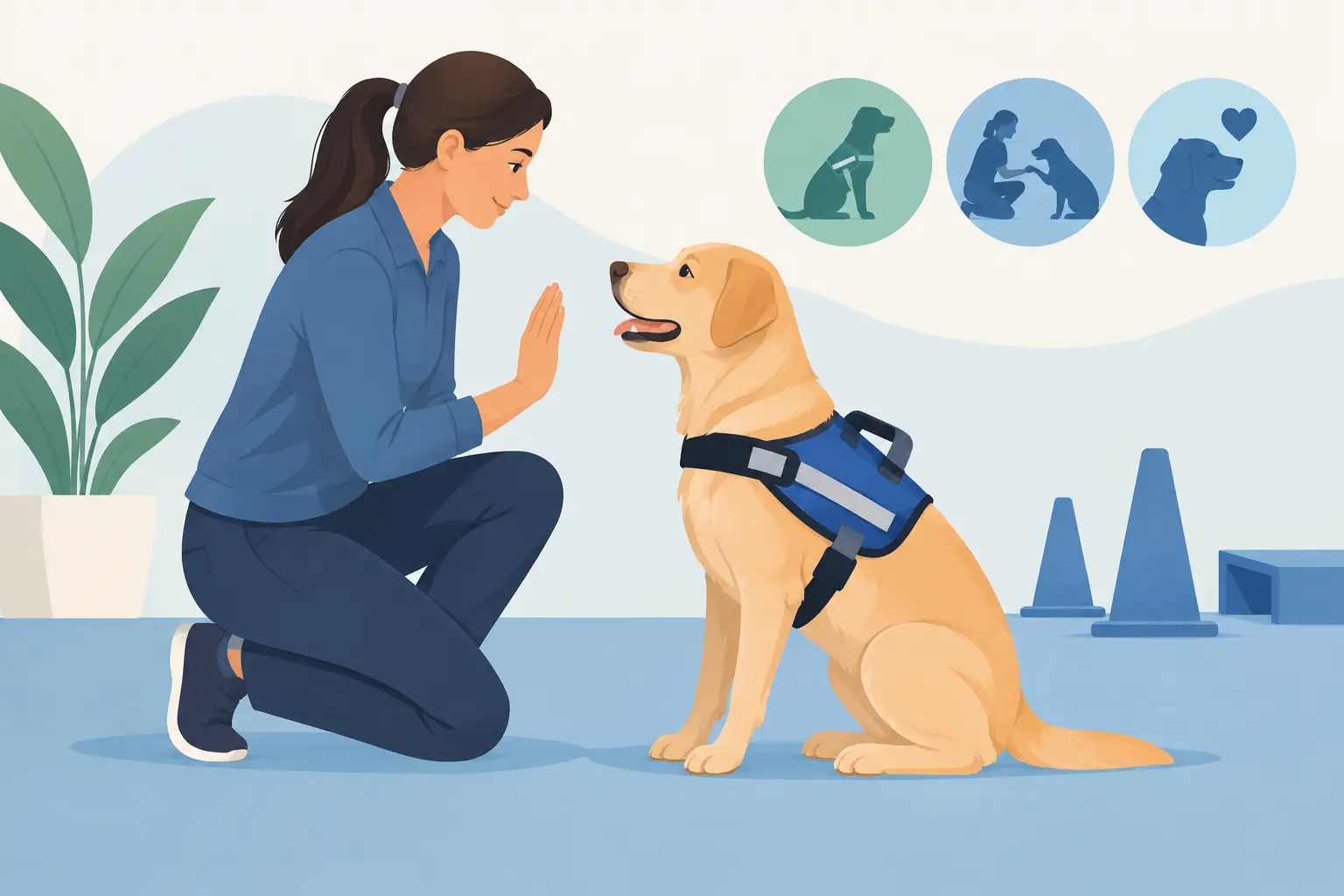
A dog that can sit nicely in a quiet living room is not automatically ready to work beside its handler in a crowded Los Angeles restaurant, a medical office, or an airport. Service animals must remain focused when doors open, carts roll by, children reach out, and daily life gets unpredictable. That level of reliability is not built with a few basic commands. It comes from purposeful training, clear standards, and consistent practice in the environments where the dog will actually work.
For a person with a disability, a well-trained service dog can provide meaningful independence and practical support. For the public, reliable behavior protects access for legitimate working teams. A trained dog is a happy dog, and a dependable service dog is one that can perform its job calmly without creating stress for its handler or the people around them.
What Service Animals Are and What They Are Not
Under the Americans with Disabilities Act, a service animal is generally a dog that has been individually trained to do work or perform tasks for a person with a disability. The task must be directly related to that person’s disability. In certain situations, trained miniature horses may also receive similar consideration, although dogs are the focus of most service animal training.
The key word is trained. A service dog is not defined by its vest, registration card, breed, or friendly personality. It is defined by trained task work and the ability to behave appropriately in public. There is no official federal registry that turns a pet into a service dog, and online certificates do not replace real training.
Examples of trained tasks can include guiding a person with visual impairment, alerting to sounds, retrieving medication or dropped items, assisting with mobility, interrupting repetitive behaviors, or responding to a medical episode. The exact task depends on the handler’s needs. What matters is that the dog performs it reliably when needed.
Emotional support can be valuable, but an emotional support animal is not the same as a service animal under ADA public-access rules. Comfort, companionship, and affection alone do not meet the task-training requirement. This distinction matters because misrepresenting an untrained pet as a service dog makes life harder for people who depend on legitimate service animals every day.
Laws can vary by setting. Housing, employment, air travel, and state or local regulations may use different standards. When questions involve a specific legal situation, speak with a qualified legal or disability-rights resource. Training professionals can prepare the dog, but they cannot decide whether a person legally qualifies for an accommodation.
Service Animal Training Starts With Daily Obedience
Before specialized task work can hold up in public, the dog needs a reliable behavioral foundation. The dog should understand how to settle, walk politely, respond promptly to cues, ignore distractions, and remain under control around people and other animals.
This is where many owners underestimate the work. A dog may know sit, down, and stay at home yet struggle in a busy store aisle or outside a school at pickup time. Real-world training is different because distractions are not scheduled, quiet, or cooperative.
A strong foundation typically includes loose-leash walking, coming when called, staying in position, leaving food or objects alone, settling under a table or beside a chair, and calmly entering and exiting buildings. Just as important, the dog must be comfortable with grooming, handling, elevators, automatic doors, unfamiliar flooring, and normal public noise.
Training should use motivation, positive reinforcement, fair boundaries, and repetition. The goal is not to intimidate a dog into silence. The goal is to teach the dog what behavior earns reward and how to make the right choice even when the environment is busy.
Task Training Must Be Specific
Task training is not a collection of party tricks. It should solve a real, repeatable problem for the handler.
For example, a dog trained to retrieve a phone must do more than pick up an item in the kitchen. The dog should recognize the cue, locate the item in different rooms, bring it safely to the handler, and perform the task despite normal distractions. A medical-alert or response task requires especially careful planning, repetition, and professional guidance because consistency is critical.
The best task-training plan starts by identifying what the handler needs help with during an ordinary week. Then the task is broken into small, teachable steps. Clear criteria prevent rushed training and give the dog a fair chance to succeed.
Public Behavior Is Part of the Job
A service dog may work in places where pet dogs are not allowed. That access brings responsibility. The dog should be housebroken, non-aggressive, and under the handler’s control. It should not bark repeatedly, lunge, sniff merchandise, solicit attention, block aisles, jump on strangers, or eat from tables.
A working dog does not need to be robotic. It can be relaxed and friendly when appropriate. But it must be able to return to work quickly and remain neutral around strangers. Public access depends on behavior, not on a vest.
Why Temperament Matters as Much as Training
Not every good dog is a good service-dog candidate. A dog can be deeply loved, highly trainable, and still be uncomfortable with the demands of public work. Forcing an anxious, reactive, noise-sensitive, or easily overwhelmed dog into that role is unfair to the dog and exhausting for the handler.
Strong candidates tend to recover quickly from surprises, enjoy working with people, accept new environments, and show steady confidence without excessive intensity. They also need sound physical health for the tasks they will perform. Breed can influence size, energy, and physical capability, but temperament and individual behavior matter more than a label.
An honest assessment early in the process can save months of frustration. Young puppies can show promising traits, but maturity changes behavior. Adult dogs may offer a clearer picture of temperament, though they can come with established habits that need work. There is no single right path. The right choice depends on the handler’s needs, timeline, and the dog in front of you.
Service Animals Need Training That Transfers
The biggest training mistake is practicing only in one familiar location. Dogs do not automatically understand that a command learned in the backyard also applies in a pharmacy, parking lot, hotel lobby, or crowded sidewalk.
Generalization is the process of teaching the same behavior in many places, around many distractions, with gradually increasing difficulty. A trainer may begin with controlled sessions, then progress to calm public environments before asking the dog to handle more challenging situations. Rushing this process can create avoidable setbacks.
Handlers need training too. A dog can have excellent skills, but the team will struggle if the handler cannot read stress signals, reward good choices, give clear cues, or manage an unexpected distraction. Successful service work is a partnership. The dog needs guidance, and the handler needs a practical system they can use every day.
For busy professionals and families, structure matters. Short, consistent sessions are more effective than occasional long sessions filled with frustration. Practice a settle during a coffee stop. Reinforce loose-leash walking on the way to the car. Work on calm waiting before entering a building. These small repetitions build the habits that hold up when the dog is needed most.
Protecting Access Through Responsible Handling
When a business has a legitimate reason to ask, staff in most ADA-covered public settings may generally ask whether the dog is required because of a disability and what work or task the dog has been trained to perform. They should not demand medical details or paperwork. Handlers who understand these basic expectations can respond calmly and keep the interaction brief.
Responsible handling also means recognizing when the dog is having an off day. Illness, fatigue, fear, or a developing behavior issue can affect performance. A responsible handler does not push through obvious signs of stress simply to prove the dog belongs somewhere. Pausing, getting support, and rebuilding skills protects the dog’s welfare and the team’s long-term success.
If barking, reactivity, leash pulling, or housebreaking problems appear, address them early. These behaviors do not automatically mean a dog cannot succeed, but they do require a clear training plan. The longer a poor habit continues, the more repetition it receives.
Professional guidance can make the process more efficient, especially when task work, public-access preparation, or behavior concerns are involved. A qualified trainer should assess the individual dog, create measurable goals, and teach the handler how to maintain progress outside of lessons. Proven results come from consistent work, not quick promises.
Start with one honest question: can your dog stay calm, responsive, and engaged with you when everyday life gets complicated? If the answer is not yet, that is not failure. It is the starting point for the focused training that gives a working dog and its handler the confidence to move forward.
