
A puppy who drags you toward every dog, chews the rug when you answer an email, or forgets housebreaking rules after one busy weekend does not need more random advice. They need a clear plan. The choice between puppy classes or private training comes down to your puppy’s temperament, your household, and the specific behavior you need to improve.
Both options can build a confident, well-mannered dog when training is consistent and practical. The best choice is not automatically the most social, the most convenient, or the least expensive. It is the format that gives your puppy the right level of guidance to succeed in your real daily life.
Puppy Classes or Private Training: The Practical Difference
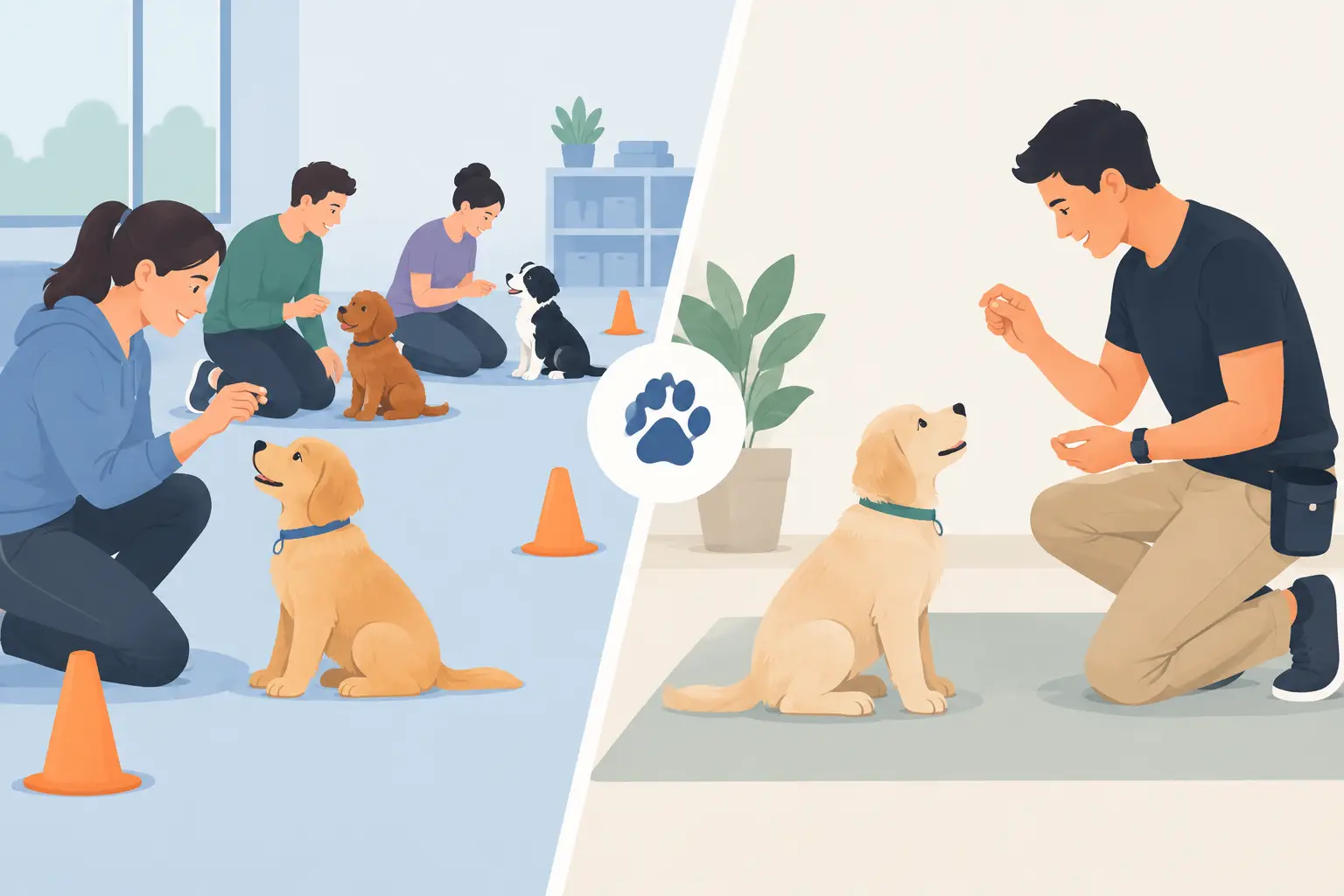
Puppy classes place several young dogs and their owners in a structured group setting. A qualified trainer guides the group through foundational skills such as attention, sit, down, coming when called, loose-leash walking, settling, handling, and appropriate social behavior. Owners practice the skills alongside normal distractions, including other people, dogs, sounds, and movement.
Private training is one-on-one instruction designed around your dog and your home. The trainer can observe what happens at the front door, during mealtimes, on walks, around children, or when your puppy is left alone. That makes private lessons especially useful when the issue is specific, urgent, or difficult to recreate in a group class.
Neither format replaces owner follow-through. Dogs do not generalize a command automatically. A puppy who sits beautifully in class still needs practice in the kitchen, on the sidewalk, near a delivery truck, and when guests arrive. Training works because the dog learns a consistent pattern: listen, respond, and earn something worthwhile.
When Puppy Classes Are a Strong Choice
A well-run puppy class is valuable for puppies that are generally comfortable around people and other dogs. It gives them a safe place to learn that other dogs do not always mean playtime and that people, noises, and activity can be handled calmly.
The biggest benefit is controlled distraction. At home, your puppy may respond quickly because the environment is familiar and quiet. In class, they learn to focus while other puppies move, bark, sniff, and play nearby. That skill matters in Los Angeles, where walks often involve busy sidewalks, patio dining, apartment hallways, visitors, and neighborhood dogs.
Classes also help owners read normal puppy behavior accurately. Mouthing, jumping, short attention spans, excitement, and occasional accidents are common. A professional trainer can show you how to respond before those habits become daily arguments. You also gain the accountability of a weekly routine, which can be helpful for busy professionals and families who need a reason to protect training time.
A class should not be uncontrolled puppy play. Good socialization is not about forcing puppies to interact with every dog or person they see. It is about creating positive, manageable exposure while teaching your puppy to remain responsive to you. Look for a program that includes rest breaks, carefully supervised interactions, clear instruction, and practical obedience work.
Classes work best when your puppy can recover
A little uncertainty in a new environment is normal. The key question is whether your puppy can settle, take treats, engage with you, and recover after a surprise. A puppy who is briefly cautious but becomes curious may benefit greatly from a thoughtful group class.
If your puppy is overwhelmed throughout the session, cannot focus at all, or escalates into frantic barking, lunging, or shutting down, a group setting may be too much right now. That does not mean your dog is a lost cause. It means the training plan should start with more individual support.
When Private Training Is the Better Investment
Private lessons are often the fastest path when a behavior is happening in your actual home and needs direct coaching. Housebreaking setbacks, crate resistance, destructive chewing, door rushing, counter surfing, leash reactivity, guarding food or toys, and intense separation-related distress all have context. The details matter.
For example, a puppy who has accidents may not be stubborn or confused about the command to go outside. The schedule may be too loose, freedom in the house may be coming too soon, or the family may be missing early signals. A private trainer can identify the pattern and help you build a schedule that works with your living space and routine.
Private training is also a strong option for families who want everyone on the same page. One person may allow jumping while another corrects it. Children may accidentally reward rough play. A trainer can explain the household rules, demonstrate the right response, and make sure each family member understands their role.
This format is particularly useful for puppies who are shy, reactive, easily overstimulated, or new to the home after a difficult start. Going slower is not falling behind. Building confidence and responsiveness before adding major distractions often produces better long-term results.
At Smart Dogs, private training is built around functional commands and behavior that carries into everyday life. The goal is not a puppy who performs for treats in one room. The goal is a dog that can settle at home, walk with you reliably, greet guests politely, and respond when it matters.
Consider Your Schedule, Not Just Your Puppy
The right training option must fit the routine you can maintain. A weekly class is effective when you can attend consistently and practice short sessions between meetings. Ten focused minutes before breakfast, a few repetitions at the door, and structured practice on a walk can create real progress.
Private training can be more efficient for households with demanding schedules because the work is tailored to the problem. You spend less time on skills your puppy already knows and more time on the behaviors disrupting your day. For a family managing work, school, and a new puppy, that focus can be worth the higher upfront cost.
Still, private lessons are not a shortcut around practice. Even the best trainer cannot install reliability in one visit. Your puppy needs repetition, fair boundaries, motivation, and clear feedback from the people they live with. Proven results come from a proven system followed consistently.
A Combined Plan Often Delivers the Best Result
For many puppies, the best answer is not one format forever. Start with private training if you need help establishing housebreaking, crate routines, family rules, or basic engagement. Then move into a structured group class once your puppy can focus and recover around distractions.
The reverse can work as well. A puppy may do well in class but need a private session for a problem that only appears at home, such as barking at the window or charging the front door. Training should adjust to the dog in front of you, not force every puppy into the same program.
Think about what you want life with your dog to look like six months from now. Do you want calm greetings, easier walks, dependable recall, and a puppy who can relax while you work or host friends? Those outcomes require more than social exposure. They require skills practiced where life happens.
Questions to Ask Before You Enroll
Before selecting a program, ask how the trainer handles fearful or overexcited puppies, how much owner practice is expected, and whether the curriculum covers real household behavior. Ask whether the class separates puppies when needed and whether private training can address the specific challenges you are seeing.
You should also pay attention to the training philosophy in action. Effective training should be clear, fair, and motivating. Your puppy should understand what earns rewards, what behavior is expected, and how to succeed. A trained dog is a happy dog because clear communication reduces confusion for everyone.
Do not wait for a small puppy issue to become the family’s normal. Choose the setting that lets you build the right habits now, practice them consistently, and enjoy more of the dog you brought home.
