
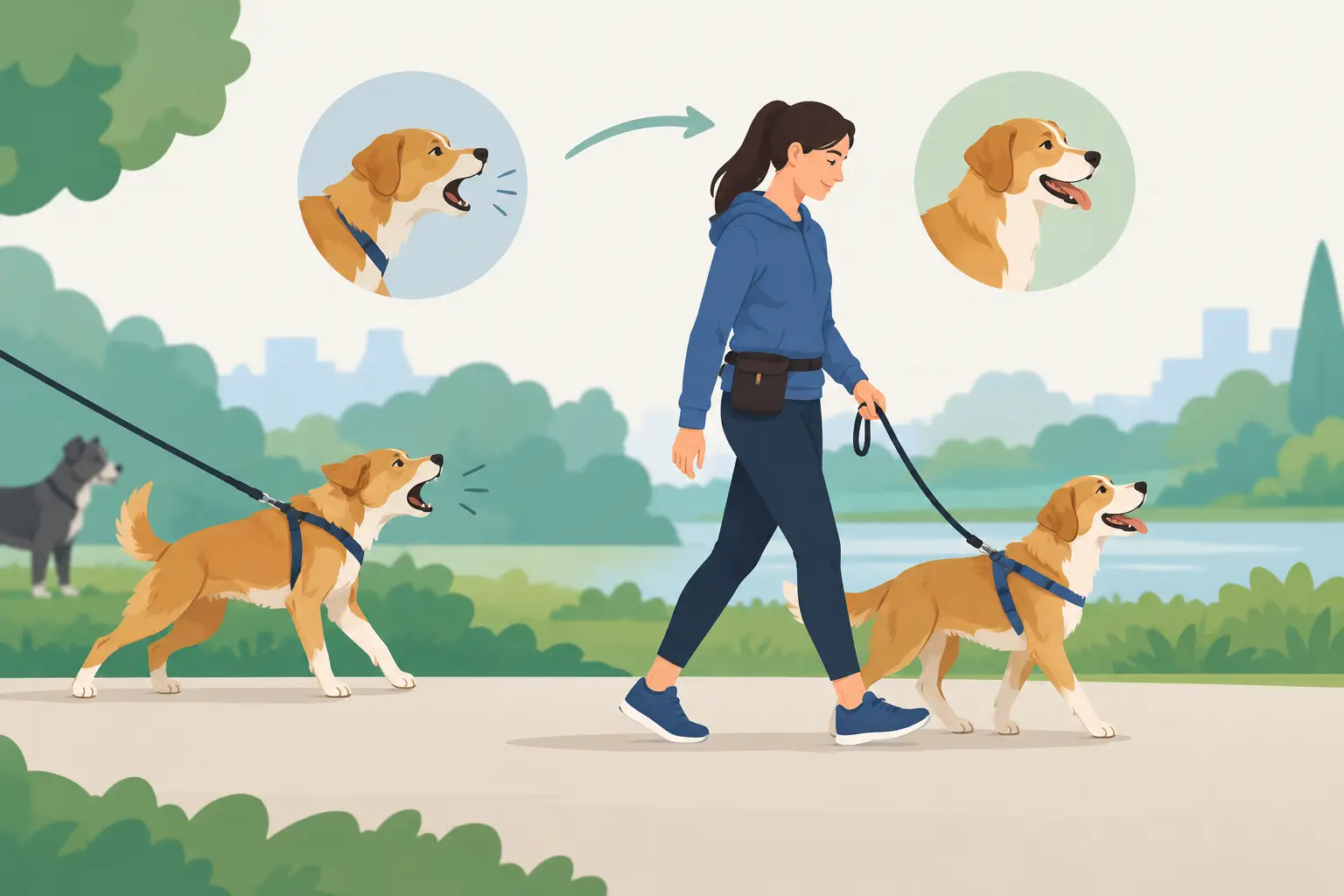
A dog can be affectionate at home, friendly with family, and still explode at the end of the leash when another dog appears. That does not mean your dog is bad or aggressive. Learning how to stop leash reactivity starts with recognizing that the leash, the distance, and the situation can make a dog feel trapped, frustrated, or overwhelmed.
For many Los Angeles dog owners, crowded sidewalks, narrow trails, apartment hallways, and busy parks make reactive walks feel unavoidable. The good news is that leash reactivity can improve with a clear plan. The goal is not to force your dog to “face their fear” or make them perfectly social with every dog they see. The goal is a calm, responsive dog that can notice a trigger, stay connected to you, and move through daily life safely.
What Leash Reactivity Really Means
Leash reactivity is an over-the-top response to something your dog sees, hears, or encounters while restrained. Barking, lunging, growling, spinning, pulling, staring, and whining are common signs. Other dogs are frequent triggers, but people, skateboards, bicycles, runners, delivery carts, cars, or sudden noises can also set a dog off.
The behavior may come from fear, frustration, excitement, previous bad experiences, or a lack of practice around distractions. A dog that wants to greet every dog can become reactive when the leash prevents that greeting. A fearful dog may bark and lunge because they have learned that making a big display causes the other dog to leave.
The reason matters, but the first training priorities are similar: create enough distance for your dog to think, teach an alternative response, and stop rehearsing the unwanted behavior. Every successful lunge can make the next lunge more likely. Every calm observation builds a better habit.
How to Stop Leash Reactivity Without Making It Worse
The most common mistake is getting too close too soon. If your dog is already barking, pulling hard, or unable to take food, they are over their threshold. At that point, they are not refusing to listen. Their nervous system is too activated to learn well.
Do not correct, yell, drag, or punish your dog for reacting. Harsh responses can suppress warning signals while increasing the negative association with other dogs or people. Your dog may begin to believe that seeing a trigger predicts discomfort from both the trigger and the handler.
Instead, calmly create distance. Turn around, cross the street, step behind a parked car, or move down a driveway until your dog can settle. Distance is not avoiding training. It is how you put your dog in a position to succeed.
A well-fitted harness and a standard six-foot leash give most owners better control without adding unnecessary pressure. Avoid retractable leashes during reactivity training. They make it harder to manage distance, timing, and safety. If your dog has a history of biting, redirecting onto the leash, or causing injury, work with a qualified professional and use appropriate safety measures before practicing near triggers.
Start With Focus at Home
A reactive walk is not the place to teach your dog their first cue. Build simple communication where your dog already feels safe. Practice their name response, a hand target, a sit, a down, and a short heel or loose-leash position in the living room, yard, or quiet hallway.
Choose one easy cue that means, “Turn your attention back to me.” It might be your dog’s name, “look,” or “with me.” Say it once, then reward the moment your dog makes eye contact. Use food your dog truly values, such as small pieces of chicken, cheese, or a favorite training treat. Kibble may be enough for some dogs, but a busy sidewalk often requires a better paycheck.
Keep sessions short. Five focused minutes done consistently will produce more reliable results than one long session that leaves everyone frustrated. A trained dog is a happy dog, and that training begins by making the right choice clear and rewarding.
Find Your Dog’s Working Distance
Next, practice around triggers from far enough away that your dog can notice them without reacting. This might be 20 feet away for one dog and 100 feet away for another. There is no prize for working too close.
When your dog sees another dog at a manageable distance, mark the calm moment with a cheerful “yes” or a click, then deliver a treat. At first, you are rewarding the simple act of seeing the trigger without losing control. Over time, many dogs begin to look at the other dog and then turn back to their handler because that pattern has been reinforced.
Watch your dog closely. A loose body, ability to sniff, soft eyes, and willingness to take food usually mean you are at a workable distance. A hard stare, closed mouth, stiff posture, raised hackles, whining, or suddenly ignoring treats mean you need more space. Respond early, before the bark and lunge happen.
Use the “See It, Turn Back” Pattern
This is one of the most useful real-world exercises for leash reactivity. Your dog sees a trigger. You mark the calm look. Your dog turns toward you for a reward. Then you either continue walking or move away, depending on the situation.
Do not demand prolonged eye contact while another dog passes three feet away. That is often too difficult and can make your dog feel trapped. The better standard is brief awareness followed by a calm check-in and forward movement.
If your dog looks at another dog and remains composed, reward generously. If they begin to load up, meaning their body gets still, their stare becomes intense, or they lean forward, use your practiced turn cue and leave. A smooth U-turn is a valuable skill for city walks. Practice it when nothing is happening so it is automatic when you need it.
Change the Walk Before You Change the Behavior
During the early stages of training, your route matters. Busy dog parks, narrow sidewalks at peak hours, and areas with off-leash dogs can create more challenges than your dog can handle. Choose wider streets, quieter neighborhoods, open fields, or times of day with fewer dogs around.
This is not a permanent restriction. It is a training decision. You are reducing repeated failures while building the skills needed for more difficult environments later. A 20-minute walk with three calm training repetitions is more productive than an hour spent pulling your dog past constant triggers.
Give your dog decompression time, too. Sniffing in a quiet area, moving at a comfortable pace, and having a predictable routine can lower overall stress. Exercise helps, but simply exhausting a reactive dog will not teach emotional control. Physical activity and structured training work best together.
When Progress Stalls
Leash reactivity rarely improves in a perfectly straight line. Your dog may do well for several walks and then struggle after poor sleep, a stressful visitor, a close encounter, or an unusually busy day. That does not erase progress. It means the situation was harder than your dog’s current skill level.
If reactions are increasing, take a step back. Increase distance, improve the value of rewards, shorten the walk, and return to easier practice sessions. Also consider whether pain or discomfort may be affecting behavior. A dog with ear pain, joint soreness, vision changes, or other medical issues can become less tolerant on walks. A veterinary check is worthwhile when behavior changes suddenly or seems out of character.
Some dogs need more individualized help, especially when they react to nearly every dog, cannot recover after an outburst, or have a bite history. Professional training can provide the timing, handling skills, and controlled setups that are difficult to create on a public sidewalk. Smart Dogs uses practical, motivation-based training to help owners build dependable responses that carry into everyday life.
Give Your Dog a Job on Every Walk
Your dog does not need to greet every person or dog to have a good life. In fact, many dogs become calmer once they learn that walks have a simple routine: walk with their person, check in when something appears, and move on.
Celebrate the small wins. A dog that notices another dog from across the street and chooses to look back at you has made real progress. Keep showing up with calm handling, good timing, and realistic expectations. The walks you want are built one successful choice at a time.
