
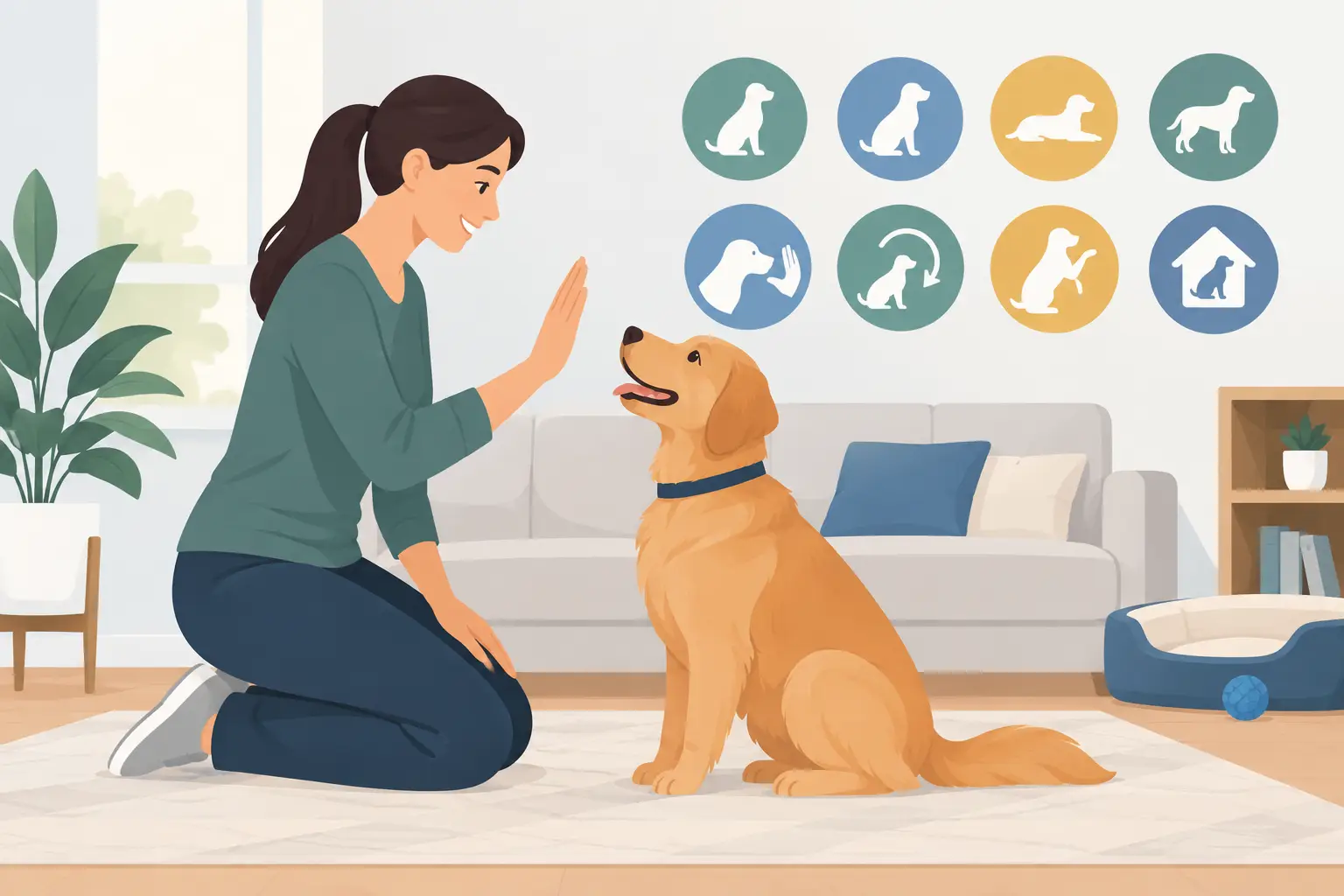
The moments that make dog ownership stressful are rarely dramatic. They happen when the front door opens, a leash clips on, dinner drops to the floor, or your dog spots another dog across the sidewalk. The dog commands every owner needs are not party tricks. They are practical tools that give your dog clear direction when excitement, fear, or distraction takes over.
A trained dog is a happy dog because predictable expectations reduce confusion. These commands help create a calmer home, safer walks, and more freedom for your dog to participate in daily life. Start with one or two, practice them consistently, and add difficulty only after your dog understands the basics.
The Dog Commands Every Owner Needs for Daily Life
1. Name recognition
Before a dog can follow a command, they need to understand that their name means, “Pay attention to me.” Say your dog’s name once in a pleasant tone. The instant they look toward you, mark the choice with praise or a reward.
Avoid repeating their name when they are ignoring you. “Buddy, Buddy, Buddy” teaches a dog that the first few repetitions do not matter. Use the name to gain attention, then give the actual instruction: “Buddy, come” or “Buddy, sit.” This small distinction makes communication much clearer.
2. Sit
Sit is one of the first commands most owners teach, but its real value comes from where you use it. A reliable sit can prevent jumping on guests, create order before meals, and slow down a dog that is rushing through doorways.
Ask for a sit before your dog gets something they want: the leash, a tossed toy, access to the yard, or a greeting. This is not about making your dog earn every good thing. It is about showing them that calm behavior works. Over time, sitting becomes their default response when they want attention or access.
3. Down
A down position asks for more relaxation than a sit. It is especially useful at home, at an outdoor restaurant, during family gatherings, or anywhere your dog needs to settle for more than a few seconds.
Some dogs find down more difficult because it leaves them less ready to move. Do not force your dog into position or push on their shoulders. Lure them down with a treat at first, reward promptly, and build duration gradually. A confident down should feel safe, not like a physical struggle.
4. Stay
Stay gives your dog a clear job when movement would cause a problem. Use it while carrying groceries inside, opening the front door, loading the car, or keeping your dog from crowding visitors.
Start close. Ask for sit or down, say “stay,” pause for one second, then reward before your dog gets up. Increase only one challenge at a time: duration, distance, or distraction. If you walk farther away and your dog breaks the command, the exercise was simply too hard at that stage. Reset without frustration and make the next repetition easier.
A release word matters just as much as stay. Choose one word, such as “free” or “okay,” and use it consistently. Your dog should learn that they hold the position until they hear that release.
5. Come
Recall may be the most important safety command your dog will ever learn. A strong “come” can stop a dog from running toward traffic, chasing wildlife, or disappearing through an open gate. It also makes off-leash recreation possible only when the setting and your dog’s skill level truly support it.
Make coming to you worthwhile. Use an upbeat voice, move backward if needed, and reward generously when your dog arrives. Never punish your dog after they come, even if they took too long or ignored you at first. If “come” regularly ends with a scolding, a bath, or the end of fun, your dog has every reason to hesitate next time.
Practice indoors, then in a fenced area, then on a long line around mild distractions. A dog that comes reliably in the living room may not be ready to respond at a crowded Los Angeles park. That is not stubbornness. It is a training gap that needs gradual practice.
6. Leave it
“Leave it” means do not engage with that item, person, food, or distraction. It is a prevention command, useful before your dog grabs chicken bones on a walk, fixates on a squirrel, or approaches something unsafe.
Teach it first with a low-value treat in your closed hand. When your dog stops trying to get it and looks away, reward them with a different treat from your other hand. The lesson is simple: moving away from temptation pays better than fighting for it.
As the behavior improves, practice with items on the floor, then with controlled distractions outdoors. Do not use “leave it” as a vague replacement for every correction. Give the command once, reward the correct choice, and manage the environment when the temptation is beyond your dog’s current ability.
7. Drop it
Leave it prevents a problem before it starts. “Drop it” addresses something already in your dog’s mouth. This command can be critical for dogs that pick up socks, trash, dangerous food, or small household objects.
Trade instead of chasing. Offer a high-value reward near your dog’s nose, say “drop it,” and reward the moment the item falls. Then, when safe, give the item back sometimes. Dogs are more willing to release objects when they do not expect every release to mean permanent loss.
Never turn this into a game of pursuit. Chasing a dog who has stolen something can create a faster thief or encourage guarding. If your dog stiffens, growls, freezes, or snaps around items, seek professional help rather than repeatedly taking things away by force.
8. Place
Place teaches your dog to go to a specific bed, mat, platform, or designated area and remain there until released. For busy households, this is one of the most useful functional commands available.
Use place during meals, while answering the door, when children are playing, or when service professionals enter the home. It gives your dog an alternative to barking, pacing, jumping, or getting underfoot. Unlike simply telling a dog “no,” place tells them exactly what to do instead.
Begin with a clear target that is large enough for your dog to lie down comfortably. Reward all four paws on the spot, then build toward a calm down and longer duration. Place is not isolation or punishment. When taught correctly, it becomes a comfortable, rewarding station.
9. Heel or “let’s go”
Every dog does not need a competition-style heel, where their shoulder stays precisely aligned with your leg. Most owners need a practical loose-leash walking command. Whether you call it “heel,” “with me,” or “let’s go,” the goal is the same: your dog moves with you instead of pulling you toward every smell, dog, and delivery truck.
Reward your dog for choosing your side and keeping slack in the leash. When the leash tightens, stop or change direction rather than letting pulling get them where they want to go. Consistency matters more than force. If pulling still works half the time, it will continue.
For reactive or highly excitable dogs, create distance from triggers and work below the point where they explode. A command cannot replace proper behavior work, but clear leash skills give you far more control while that training is underway.
10. Wait
Wait is a brief pause command. It is less formal than stay and ideal for thresholds: doors, cars, elevators, gates, and food bowls. Your dog does not need to hold position for several minutes. They simply need to pause until you give permission.
This command is particularly valuable in apartment buildings and busy family homes, where a rushed exit can lead to a loose dog or an uncomfortable encounter in a hallway. Ask for wait before opening the door, open it only a few inches at first, and close it calmly if your dog surges forward. Release them when they can remain composed.
How to Make Commands Reliable
Dogs do not generalize commands automatically. Your dog may know “down” in the kitchen and struggle with it at a friend’s house, near children, or when another dog is nearby. Practice in short sessions across different rooms and real-life situations. Three focused minutes before a walk can be more valuable than one long, frustrating training session on the weekend.
Use a clear command once, reward the correct response quickly, and keep your expectations fair. If your dog is tired, overstimulated, frightened, or facing a distraction they have not been prepared for, step back and make the exercise easier. Reliable obedience is built through repetition and good timing, not by getting louder.
For puppies, keep sessions brief and upbeat. For rescue dogs, allow time to build trust and learn the rules of a new home. For adult dogs with established habits, expect progress, but be prepared to replace old routines with better ones through daily consistency. The approach changes, but the goal remains practical: a dog that understands what is expected and can succeed.
The best command is the one you can use calmly when real life gets busy. Practice these skills before you need them, reward the behavior you want to see again, and let each small success build a safer, more enjoyable life with your dog.
