
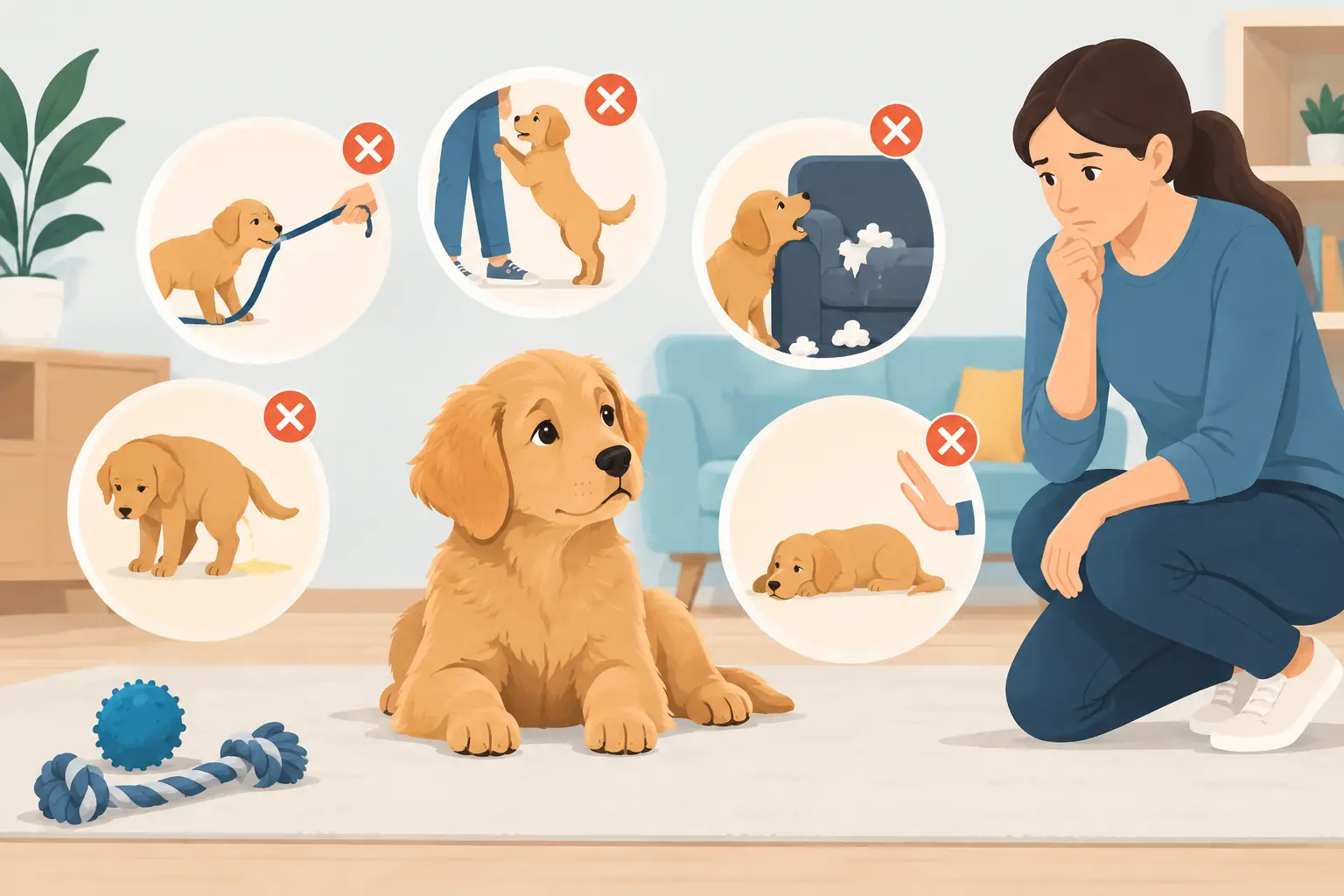
A puppy who has an accident on the rug, pulls toward every stranger, or ignores their name is not being stubborn. More often, they are responding exactly as they have been taught – even when that teaching was unintentional. The most common puppy training mistakes happen when loving owners are tired, busy, or simply working without a clear plan. Early habits matter because puppies practice them hundreds of times before they reach adolescence.
A trained dog is a happy dog, and effective puppy training does not require harshness or hours of complicated drills. It requires consistency, good timing, clear expectations, and management that prevents your puppy from rehearsing unwanted behavior.
Puppy Training Mistakes to Stop Early
1. Waiting for your puppy to outgrow behavior
Many owners wait on jumping, nipping, barking, pulling, or accidents because their puppy is small and cute. But behavior that earns attention, access, movement, or excitement tends to continue. A 12-pound puppy jumping on guests may be amusing. A 70-pound adolescent doing the same thing is stressful and potentially unsafe.
Do not expect maturity alone to solve a behavior that your puppy practices every day. Teach the alternative you want. For jumping, that may mean four paws on the floor or sitting to greet people. For chewing, provide an appropriate chew item and calmly redirect before your puppy finds the table leg.
2. Giving too much freedom too soon
Freedom should be earned in stages. A puppy with full access to the home before they are reliably housebroken will find quiet places to have accidents, chew cords, steal food, or practice ignoring you. Every successful repetition makes the habit stronger.
Use a crate, exercise pen, leash supervision, and baby gates thoughtfully. This is not about confining your puppy all day. It is about creating a safe environment while you build reliability. When you cannot actively supervise, your puppy should be in a secure, comfortable area with an appropriate activity.
3. Treating housebreaking as a guessing game
Housebreaking improves fastest when the schedule is predictable. Puppies need frequent trips outside, especially after waking up, eating, drinking, playing, and chewing. Taking them out only when they appear desperate often means you are already behind.
Bring your puppy to the same designated area, wait calmly, and reward immediately after they finish. The reward needs to happen outside, not after you return indoors. If an accident happens, clean it thoroughly and adjust your supervision or potty schedule. Punishing a puppy after the fact does not explain where they should go. It may only teach them to hide when they need to relieve themselves.
4. Repeating commands until they lose meaning
Saying sit, sit, sit, sit teaches a puppy that the first few cues are optional. The same problem develops when owners call a puppy over and over at the dog park, then finally walk toward them in frustration.
Give a command once in a calm, clear voice. If your puppy does not respond, help them succeed by reducing distance, removing distractions, or using a leash to guide the situation without anger. Then reward the correct response. A command becomes reliable when it consistently predicts a clear outcome.
5. Calling your puppy only when fun ends
Recall is one of the most valuable skills your dog will ever learn. Unfortunately, many puppies learn that come means leash up, leave the park, stop sniffing, or get a bath. From the puppy’s perspective, ignoring you becomes the better deal.
Practice recall in easy settings and make coming to you worthwhile. Reward generously, praise warmly, and often release your puppy back to what they were doing. If every recall ends the fun, your puppy will start weighing their options. In early training, you want the answer to be simple: coming to you pays.
6. Socializing without structure
Socialization is not letting every person, dog, and child rush up to your puppy. Flooding a puppy with overwhelming experiences can create fear instead of confidence. The goal is not for your dog to greet everyone. The goal is for your dog to feel safe, neutral, and responsive around the world.
Introduce new sights, surfaces, sounds, people, and stable dogs at a pace your puppy can handle. Watch their body language. A puppy who freezes, retreats, hides behind you, or refuses food may need more distance and a slower introduction. Calm observation can be just as valuable as direct interaction.
7. Rewarding excitement by accident
Puppies quickly notice what gets a reaction. If barking brings conversation, pawing earns petting, and frantic spinning gets the leash clipped on faster, those behaviors have been rewarded. Even telling your puppy no can feel like attention when they are eager for engagement.
Be intentional about what you reinforce. Offer attention, movement, food, and access when your puppy is calm or making a good choice. Ask for a brief sit before putting down the food bowl, opening the door, greeting a visitor, or tossing a toy. These small moments build everyday self-control without turning your home into a constant training session.
8. Training only in the living room
A puppy who sits perfectly in your quiet home has not necessarily learned to sit at the park, outside a coffee shop, or when a neighbor walks by. Dogs do not automatically generalize commands as broadly as people expect. New locations, smells, movement, and noise can make an easy skill feel brand new.
Start where your puppy can succeed, then gradually add distractions. Practice a few minutes in the yard, on a calm sidewalk, near a busier street, and around other people from a comfortable distance. If your puppy cannot respond, the environment is too difficult right now. Step back, make it easier, and build again.
9. Expecting consistency from the puppy, but not the household
Mixed messages slow training down. One family member allows the puppy on the couch, another scolds them for it, and a third occasionally feeds them dinner scraps from the table. The puppy is not confused because they are difficult. They are confused because the rules change.
Decide the household standards before problem habits get established. Everyone does not need to train exactly the same way, but everyone should support the same boundaries and use the same core commands. Consistency is especially important for busy families, where small exceptions can become daily patterns quickly.
10. Waiting too long to ask for professional help
Owners often seek training only after a puppy has become an adolescent with stronger habits, bigger reactions, and more confidence in unwanted behavior. Early guidance is usually easier, faster, and less stressful for everyone. This is particularly true for fearfulness, guarding, intense biting, separation concerns, or reactivity around dogs and people.
Professional training should give you more than a collection of tricks. A proven program teaches you how to communicate clearly, manage real-life situations, and build dependable obedience that fits your routine. At Smart Dogs, the focus is practical: calmer behavior at home, better responsiveness outside, and skills owners can use every day.
Build the Habits You Want to Live With
Puppy training is not a test your dog passes in a few weeks. It is a series of small choices that become a lifestyle. Keep sessions short, reward behavior you want repeated, and set up the environment so your puppy has more chances to succeed than fail.
Some days will be messy. There will be missed potty breaks, chewed items, and moments when your puppy seems to forget everything they knew yesterday. Stay calm, return to the plan, and make the next repetition easier. The steady work you put in now creates the dog who can relax beside you, greet people politely, and listen when it counts.
