
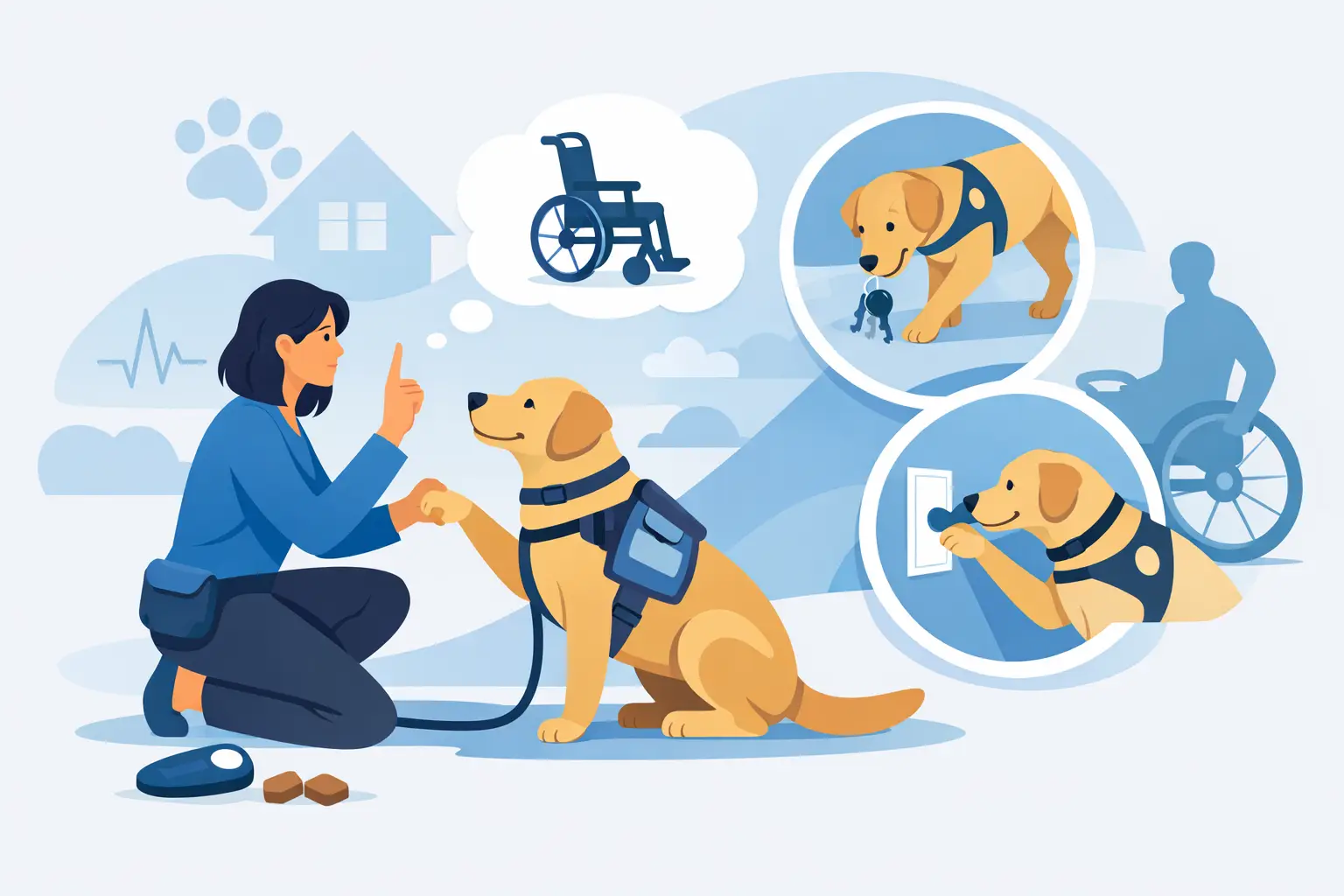
A service dog task is not a trick performed on cue for attention. It is a trained behavior that directly helps one person manage the effects of a disability. That distinction should guide every decision about how to train service dog tasks. The goal is not to teach the longest list of impressive behaviors. The goal is reliable, useful assistance in the places and moments where the handler needs it most.
A dog may learn to retrieve medication, interrupt repetitive behavior, provide a trained alert, pick up dropped items, guide a handler to an exit, or create space in a crowded setting. The right task depends on the handler’s individual needs, the dog’s abilities, and the environment where the team will work. Clear training creates a dog that is confident, responsive, and truly helpful – not overwhelmed by a job it does not understand.
Start With the Need, Not the Task List
Before training begins, define the practical problem the dog will help solve. Ask what happens during a difficult moment, what the handler can and cannot do independently, and what specific action from a dog would reduce risk or increase independence.
For example, a person with limited mobility may need a dog to retrieve a phone from another room. A person who experiences anxiety in public may benefit from a dog trained to perform a cue-based grounding behavior, such as nose nudging or placing its chin on a lap. Someone prone to disorientation may need the dog to locate a familiar person, vehicle, or exit on command. Each is a concrete behavior with a clear purpose.
Be precise. “Help with anxiety” is too broad to train. “Nudge my hand when I start picking at my skin” or “place your chin on my knee when I give the cue” gives you an observable behavior to teach and reinforce. A defined task also makes it easier to evaluate whether the dog is actually performing reliably.
Build the Obedience Foundation First
A service dog cannot perform advanced tasks consistently without strong everyday obedience. Before asking a dog to retrieve a wallet in a busy store or interrupt a behavior in a crowded waiting room, establish calm, dependable responses at home and around ordinary distractions.
Your dog should be comfortable with leash manners, recall, sit, down, stay, place, leave it, and polite behavior around people, dogs, food, noises, and changing environments. Just as important, the dog should be able to settle quietly. A service dog spends a great deal of time waiting under tables, beside chairs, in lobbies, and near moving foot traffic.
Temperament matters as much as training. A dog that is fearful, reactive, easily overstimulated, or uncomfortable around strangers may need behavior work before task training, and some dogs are not suited to service work at all. That is not a failure. Matching the job to the dog protects the dog’s welfare and gives the handler a more dependable outcome.
Use positive reinforcement and motivation to build engagement. Food, toys, praise, access to a favorite activity, and calm affection can all be effective rewards. The best reward is the one that matters to your dog in that moment. Start where the dog can succeed, reward quickly, and keep sessions short enough that accuracy stays high.
How to Train Service Dog Tasks Step by Step
Most service tasks become manageable when you break them into small pieces. Trying to teach the finished behavior all at once often creates confusion. Instead, teach one clear action, attach a cue, then gradually add distance, duration, distractions, and real-life context.
Teach the action before naming it
Suppose you want to teach a medication retrieval task. Begin by rewarding the dog for looking at and moving toward the medication pouch. Next, reward a nose touch or paw touch. Then teach the dog to take the pouch gently, hold it, turn back toward you, and place it in your hand. Only after the movement is predictable should you add a verbal cue such as “meds.”
This approach applies to nearly every task. For a nudging task, first reward a nose touch to your hand. Move the target to your leg, then reward a firmer and more intentional nudge. Once the dog offers the behavior consistently, add the cue. For an item retrieval, teach interest in the item, then pick up, hold, carry, and delivery.
Avoid repeating a cue while the dog guesses. Say it once, help the dog succeed if needed, and reward the correct response. Repeated commands teach dogs that the first request is optional.
Shape for accuracy and safety
Shaping means rewarding small improvements until the full behavior is in place. It is especially valuable for tasks requiring a sequence, such as opening an accessible door, retrieving an item from a specific location, or leading a handler to a designated person.
Keep criteria clear. If you are teaching a dog to bring a phone, decide what “finished” looks like: the dog finds the phone, picks it up safely, returns directly, and places it in the handler’s hand. Do not reward a halfway version forever. Raise expectations gradually, but make sure the dog understands what earned the reward.
Safety is nonnegotiable. Do not train dogs to pull a person, brace a person’s weight, or perform mobility support without qualified professional guidance, veterinary input, and equipment appropriate to the dog’s physical structure. Poorly planned mobility work can injure both dog and handler.
Practice in the situations that matter
A task that works perfectly in the living room is not finished. Service dogs must generalize their training. Practice first in another room, then in the yard, a quiet public setting where dogs are permitted, and eventually in more distracting locations as the dog is ready.
Change one challenge at a time. Add distance before adding noise. Add a familiar visitor before trying a busy environment. If performance falls apart, the dog is telling you the training step was too large. Go back to an easier version, rebuild success, and progress more gradually.
For alert-based tasks, extra care is needed. A dog may learn to respond to a handler’s visible changes, scent changes, movement patterns, or routines, but not every dog will develop a reliable natural alert. Never assume an alert is dependable because it happened once or twice. Track repetitions, test carefully, and maintain another safety plan until the behavior is proven over time.
Train for Reliability, Not Just Compliance
A trained task must happen when the handler needs it, not only when the dog expects a treat. Once the behavior is solid, begin varying rewards. Continue to reward good work, but do not pay in the exact same way every time. This helps the dog stay committed to the cue rather than working only when it sees food.
Reliability also means the dog can recover from normal disruptions. A dropped pan, a child running past, a door opening, or a stranger speaking should not end the dog’s ability to respond. Proofing is the process of practicing around these distractions in a controlled way.
Watch the dog closely during proofing. Stress signals such as lip licking, yawning, turning away, freezing, scanning, refusing food, or suddenly losing known skills can mean the environment is too difficult. A service dog should be focused and comfortable, not pushed through fear. A trained dog is a happy dog, and calm confidence produces better work than pressure ever will.
Keep Public Access and Task Work Separate
Task training is only part of preparing a service dog. Public access behavior is its own skill set. The dog must remain under control, avoid unwanted greetings, ignore food and other animals, toilet appropriately, and settle quietly without disrupting others.
Do not rush public environments because a dog knows several tasks. Public work places real demands on a dog, particularly in busy Los Angeles settings where sidewalks, traffic, elevators, patios, and crowded stores can create constant distractions. Start with short, successful outings and leave before the dog becomes tired or overstimulated.
Service dog laws and access rules can vary by location and circumstance. A vest, registration, or online certificate does not replace legitimate task training or good behavior. Focus on the work your dog performs, your ability to maintain control, and the standards that allow the team to move through daily life respectfully.
When Professional Support Makes Sense
Some tasks are simple to start at home. Others require careful planning, especially when they involve medical alerts, mobility assistance, complex retrievals, or behavior interruption. A professional trainer can assess whether the dog’s temperament fits the work, build a realistic training plan, and help solve the problems that often appear when training moves beyond the house.
Smart Dogs uses practical, motivation-based training to help owners build functional behavior that holds up in real life. The best program is not the one with the most commands. It is the one that gives the handler meaningful support and gives the dog a clear, fair job it can perform with confidence.
Train one useful behavior well, practice it where life actually happens, and protect your dog’s comfort at every stage. That is how a task becomes dependable help rather than just another command.
