
When the Impact Goes Deeper
For Jeff Todd, dog training has always been about more than teaching obedience or correcting behavior. Sometimes, you begin by helping a family solve a problem with their dog, only to discover later that the work made a difference in ways you could never have predicted. Throughout his career and his work with Smart Dogs Academy, Jeff has experienced moments that have reminded him why this profession matters so much.
When Training Changes More Than Behavior
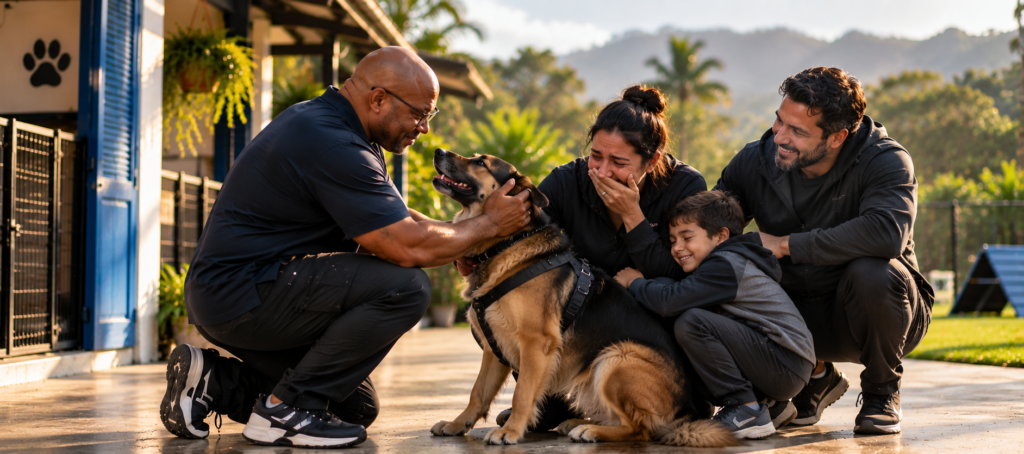
One experience that has stayed with me involved a family with three male dogs. The dogs were fighting, the family was facing veterinary bills, and their German Shepherd had developed serious behavioral problems. He was lunging aggressively at people, and the family was struggling to manage the situation safely.
We worked on obedience, control, and consistency, but an important part of the process was teaching the owners how to handle their dogs and maintain what they learned. Over time, the dogs became more manageable, the fighting stopped, and the household grew calmer. Their young son, who was around seven years old, was even able to walk the family’s little French Bulldog.
At the time, my focus was on helping the family regain control of their situation. I had no idea how important that progress would soon become.
Not long afterward, the husband suffered a brain aneurysm and two strokes while working in Las Vegas. His wife and son went there to be with him during his hospitalization and recovery. Because the dogs had become manageable and the family knew how to handle them, they were able to bring all three dogs with them.
His wife later told me that without the training, she might have had to leave the dogs behind or consider rehoming them. Her family was already facing an incredibly difficult situation, and losing their dogs would have made it even harder.
Then something happened that I will never forget. The same German Shepherd who had once lunged aggressively at people became a regular visitor at the hospital. The doctors and nurses loved him, and he was able to spend time beside his owner.
Think about that transformation. We had started by working on behavior and obedience, but the results helped a family stay together with their dogs during a medical crisis. And a man going through one of the most frightening periods of his life was able to have his beloved companion near him.
That experience reinforced something I’ve come to understand through my work as Jeff Todd: dog training can have an impact far beyond the lesson itself. Sometimes, it helps a family keep a dog they love. Sometimes, it makes it possible for that dog to be there when someone needs companionship the most.
The Comfort of a Well-Trained Companion
I’ve also thought a lot about people who lose a spouse. When someone loses their life partner, the home can suddenly feel empty. Daily routines change, companionship disappears, and even ordinary tasks can feel different.
A dog cannot replace a husband or wife, but a dog can provide comfort, companionship, and a renewed sense of purpose. That relationship can become especially meaningful during a period of grief.
Now imagine someone who is already struggling emotionally but also has to manage a dog that pulls on the leash, barks constantly, destroys things, or cannot settle at home. Instead of providing comfort, the dog may become another source of stress.
Now imagine the difference when that same dog walks calmly beside its owner, responds when called, settles at home, and can accompany them on outings without creating anxiety. The owner can enjoy the companionship instead of constantly worrying about what the dog might do next.
There is comfort in having a reason to get up in the morning, someone to care for, and a companion who is there through the quiet moments. When training helps make that relationship easier and more enjoyable, its value reaches far beyond good manners.
The Difference We Don’t Always See
After personally training more than 25,000 dogs, I’ve learned that the real value of training often goes beyond what we see during a session. You might think you’re teaching a dog to walk nicely on a leash, but you’re also helping an older person maintain their independence. You might be teaching a dog to settle down at home, but you’re helping its owner feel more comfortable in a house that has become difficult to live in.
You might begin by helping a family manage aggression or reactivity, only to discover that the progress allows that dog to remain with the people who love it. These outcomes aren’t always something you can measure with a command or demonstrate in a training session, but they can mean everything to the people experiencing them.
That’s what I want people to understand about Smart Dogs Academy. We’re not simply teaching dogs to follow commands. We’re helping people build safer, stronger, and more rewarding relationships with their dogs, whether they’re going through one of the happiest chapters of their lives or one of the hardest.
Every case is different, but the moments I remember most aren’t necessarily the ones where a dog learns an advanced command or performs beautifully. They’re the moments when an owner tells me that life has become better because of the work we did together.
Those are the moments that remind me why this work matters. You may begin by training a dog, but the impact can reach an entire family. And sometimes, that impact is felt at exactly the moment that family needs it most.
“You may start by training a dog, but the difference you make can reach an entire family.”
— Jeff Todd, Smart Dogs Training Academy