
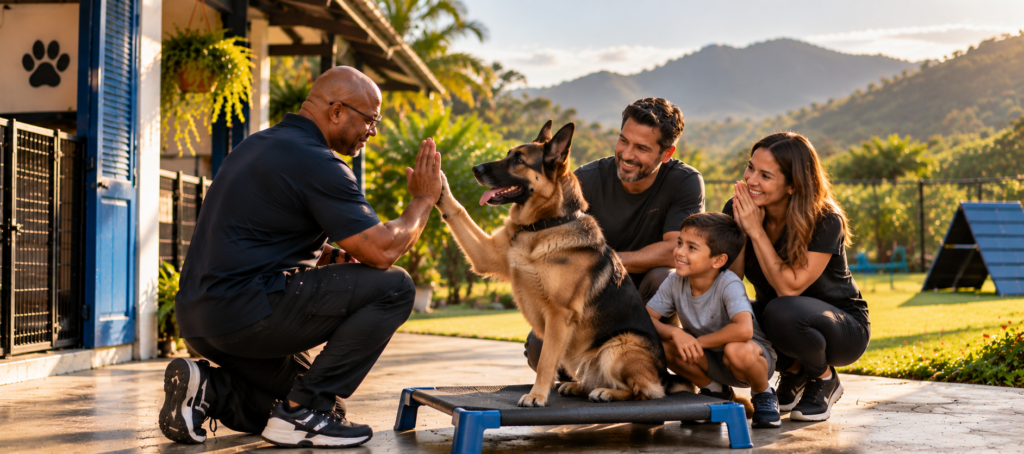
When a Family Finds Peace
One of the most rewarding parts of being a dog trainer is seeing the stress leave a family’s faces as they begin to enjoy their dog again. Instead of worrying about what might happen next, they can relax, feel confident, and build the relationship they hoped for when they first brought their dog home.
As Jeff Todd, I’ve personally trained more than 25,000 dogs, and I’ve seen how serious behavior problems can affect an entire household. Walks become stressful, visitors are a concern, and sometimes families begin to wonder if they can keep a dog they love. Love matters, but when behavior becomes difficult to manage, families need the right guidance and practical tools.
At Smart Dogs Academy, my job is about more than teaching commands. I need to understand what’s causing the problem, find an approach that works for that particular dog, and show the owners how to communicate clearly and maintain progress at home. Every dog and family is different, and the training has to reflect that.
When Training Makes a Difference Beyond the Home
I remember working with a family whose three male dogs were fighting. The situation had led to veterinary bills and a great deal of stress. Their German Shepherd was also lunging at people, making it difficult for the family to manage everyday life.
Through obedience training and consistent work with the owners, we helped bring the dogs under control and restore peace in the household. But not long afterward, the family faced a much bigger challenge. While working in Las Vegas, the husband suffered a brain aneurysm and two strokes. His wife and young son needed to be with him during his hospitalization and recovery.
Because of the progress they’d made with the dogs, the family was able to bring all three with them. His wife later told me that without the training, she might have had to give them up during an already heartbreaking time.
Then something happened that I never forgot. The same German Shepherd who had once lunged at people became a welcome visitor at the hospital. The doctors and nurses loved him, and he was able to spend time beside his owner while he recovered.
We had started out addressing obedience and behavior, but the results reached far beyond training. The family could stay together with their dogs, and a man going through a frightening medical crisis could have his beloved companion near him. That experience reminded me that sometimes the value of training becomes clear in ways you could never have planned.
Helping Children Feel Confident Around Their Dogs
Another family I worked with had three young children who were struggling to feel comfortable around their dog. The parents were stressed, and the children weren’t sure how to interact with the animal. A relationship that should have brought joy had become another source of worry.
We worked on the dog’s behavior, but just as importantly, I helped the parents understand how to give clear direction, establish boundaries, and handle everyday situations more confidently. The children learned appropriate ways to interact with their dog and became more comfortable participating in the family’s progress.
Over time, the household became calmer. The children felt more confident because they understood what to expect and how to behave around the dog. The parents gained practical tools to guide those interactions and continue the work after training.
Experiences like this can teach children patience, consistency, awareness, and respect for another living creature. Of course, young children should never be expected to manage a dog’s behavior on their own. Adult supervision and clear safety boundaries are essential. The goal is to help the whole family interact safely and give parents the confidence to guide their children and their dog.
The Real Meaning of Success
These two families faced very different challenges, but both remind me why I do this work. In one case, training helped a family keep their dogs during a serious medical crisis. In another, it helped children feel safer and gave their parents a better way to manage life with their dog.
That’s what I want Smart Dogs Academy to provide: a path from frustration and uncertainty to understanding, confidence, and enjoyment. I want owners to feel equipped rather than helpless, and I want dogs to have the opportunity to thrive in loving homes.
After training more than 25,000 dogs, I’ve learned that the most meaningful results aren’t always the most impressive commands or demonstrations. Sometimes success is a peaceful home, a child who feels confident, a family enjoying a walk together, or an owner who no longer feels overwhelmed by a dog they love.
When a family finally feels comfortable and confident with a dog they once struggled to manage, they’re getting more than a better-behaved dog. They’re getting their relationship back.
That’s the philosophy behind my work and Smart Dogs Academy. I’ve always believed that a trained dog is a happy dog. When dogs understand what’s expected of them and owners know how to guide them, families have a better chance to enjoy life together.
“When a family gets its relationship with its dog back, that’s when I know the work has truly mattered.”
— Jeff Todd, Smart Dogs Academy