
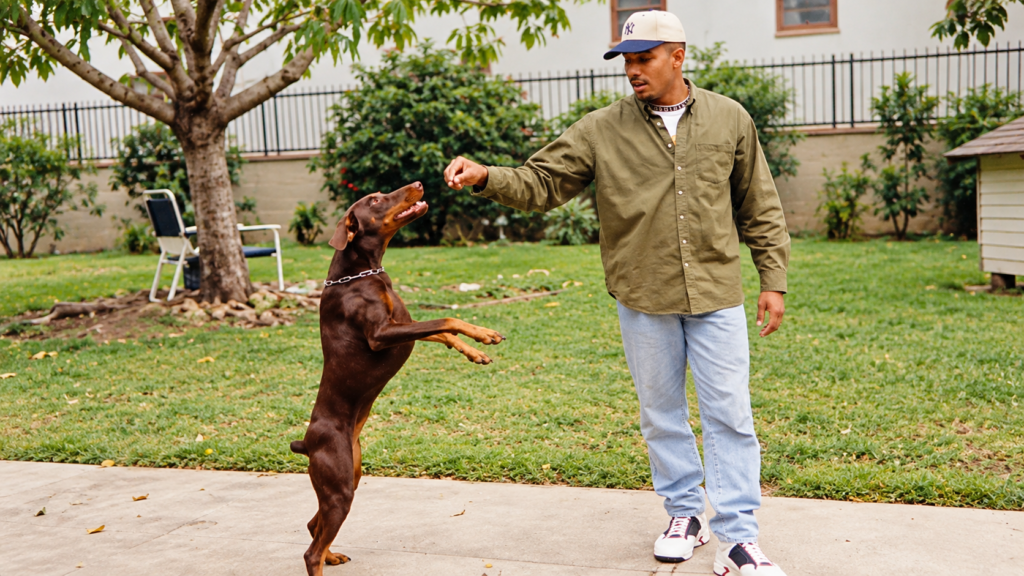
From Obedience to Understanding: How My Training Philosophy Evolved
When I first started training dogs, I was primarily focused on getting the dog to perform the behavior.
If I said “sit,” I wanted the dog to sit. If I said “down,” I wanted the dog to lie down. If I called the dog, I wanted the dog to come.
At that stage of my career, success was largely measured by the physical response.
But the more dogs I trained, the more I realized there was a significant difference between a dog that simply performs a command and a dog that wants to work with you.
That distinction changed the way I trained.
I started paying much more attention to the dog’s motivation and attitude. I wanted to create a dog that wasn’t simply going through the motions because it had to, but one that was engaged, interested, and genuinely motivated to respond.
From Compliance to Motivation
I began incorporating much more reward-based training into my approach.
And I saw a remarkable difference.
When a dog understands what you want and has a meaningful reason to do it, training becomes a completely different experience.
The dog begins to anticipate the interaction. You see more engagement, more enthusiasm, and often much greater reliability.
I remember seeing dogs that had technically learned the commands but looked like they were simply checking boxes.
“Sit? Fine. Down? Whatever. Come? Do I have to?”
Then you work with that same dog differently. You find what motivates it, make the training meaningful, and reinforce the behaviors you want.
And suddenly, its attitude changes.
The dog starts participating in the training rather than simply enduring it.
That was a major evolution in my thinking.
Learning to Communicate Rather Than Just Command
Over the years, I also came to understand that training isn’t really about how many commands a dog knows.
It’s about communication.
A dog can’t read your mind.
If you want a behavior, you have to teach the dog what that behavior means, establish a clear expectation, and then give the dog a reason to repeat it.
That doesn’t mean eliminating structure or boundaries.
Dogs still need rules, consistency, and accountability.
But I’ve learned that structure works best when the dog also understands how to succeed within it.
Over time, my goal became much clearer.
“I want the dog to understand what I’m asking, know how to succeed, and want to participate.”
— Jeff Todd, Smart Dogs Training Academy
Experience Changes How You See Behavior
Early in your career, it’s easy to look at an unwanted behavior and think, “How do I stop this?”
Experience taught me to ask a different question.
“Why is the dog doing this in the first place?”
That simple change in perspective can completely alter a training program.
A dog that won’t come when called may not be stubborn.
A dog that won’t sit may be distracted, confused, anxious, or insufficiently motivated.
A dog that reacts to another dog may not simply be aggressive. There may be fear, frustration, excitement, lack of social experience, or some combination of factors behind the behavior.
The more dogs I worked with, the more I learned to look at the whole dog rather than just the behavior in front of me.
Understanding what’s causing a behavior gives you a much better opportunity to address it appropriately.
The Dog Should Tell You How to Train It
One of the biggest changes in my philosophy has been learning to adapt.
There are training principles that apply broadly, but there isn’t one formula that works equally well for every dog.
Some dogs are highly food motivated.
Others couldn’t care less about a treat but will do anything for a ball.
Some are motivated by toys, play, movement, praise, attention, or simply interacting with their handler.
So I don’t start with the assumption that I know what will motivate a dog.
I figure it out.
That’s where experience becomes so valuable.
After working with thousands of dogs, you begin to recognize subtle differences in temperament, drive, confidence, sensitivity, and motivation.
You learn when to push, when to back off, when to change your approach, and when the dog is telling you that you’re simply not communicating effectively.
Those observations help you develop a training approach that makes sense for the individual dog rather than expecting every dog to respond the same way.
What I Believe About Dog Training Today
Today, I don’t consider a dog fully trained simply because it can perform a command.
I want to see understanding, reliability, engagement, and motivation.
I want the dog to know what is expected, but I also want the dog to have a reason to participate.
That’s one of the biggest differences between the trainer I was early in my career and the trainer I am today.
I started out teaching dogs what to do.
Over the years, I learned to teach them why they should want to do it.
And when you can combine clear communication, structure, consistency, appropriate boundaries, and genuine motivation, you get something much more valuable than a dog that simply obeys.
“You get a dog that is engaged with its handler and wants to work with you.”
— Jeff Todd, Smart Dogs Training Academy
Why I Still Love Training Dogs
That evolution in my thinking has become an important part of the philosophy behind Smart Dogs Training Academy.
My approach today is about more than teaching commands or producing a physical response.
It’s about understanding the dog, communicating clearly, establishing appropriate expectations, and creating a training experience where the dog is motivated to participate.
Every dog brings a different personality, a different set of challenges, and another opportunity to learn.
And that’s one of the reasons I still love training dogs after all these years.