
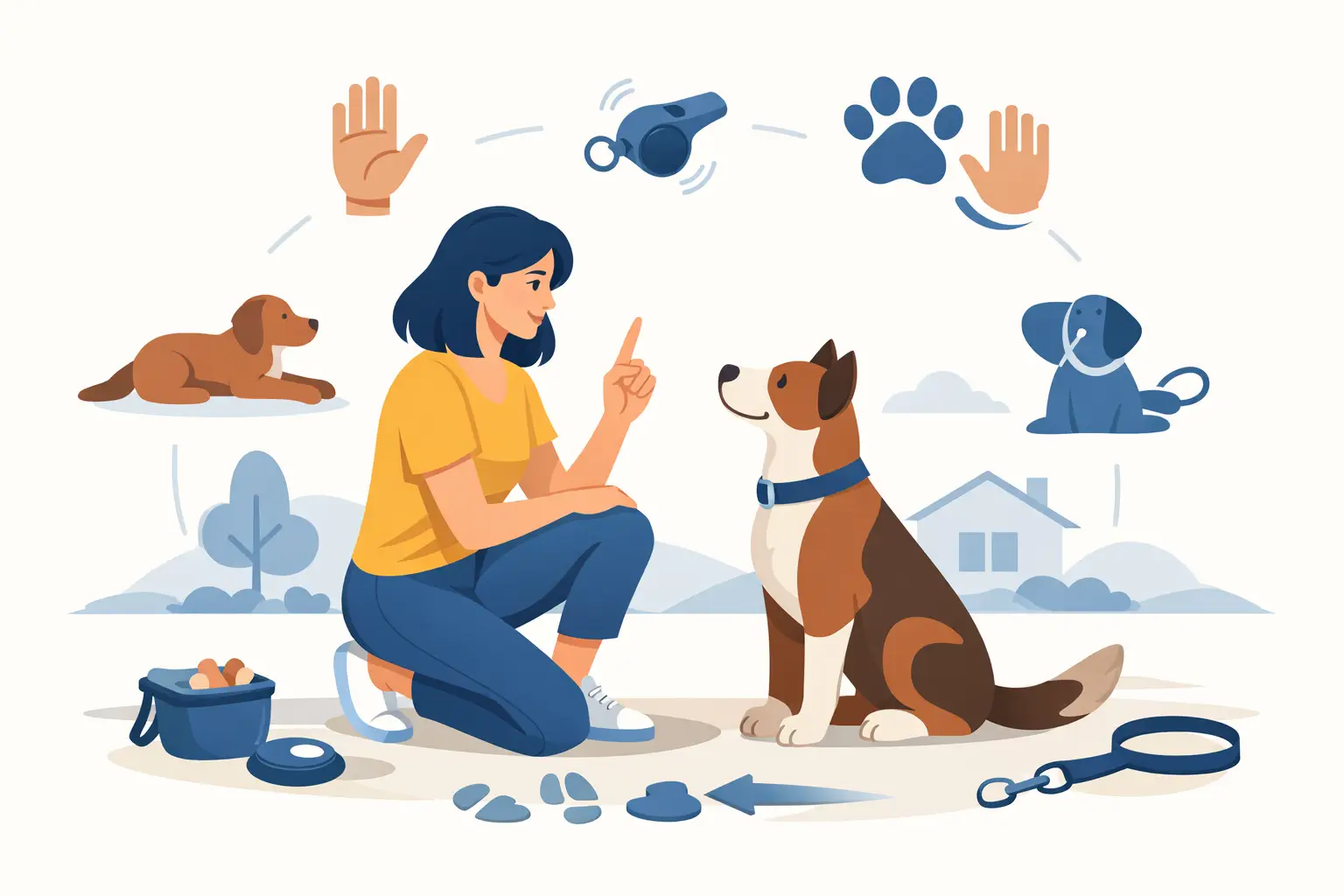
A dog who understands what is expected can relax. So can the person holding the leash. This best dog training commands list focuses on the cues that make the biggest difference in daily life: getting out the front door calmly, settling when guests arrive, walking safely near distractions, and responding when it truly matters.
The goal is not to collect tricks. It is to build clear communication your dog can rely on anywhere. A trained dog is a happy dog, and a reliable command system helps create a calmer home, safer walks, and more freedom for everyone.
Start With Clear, Consistent Training
Before teaching more commands, make the ones you use mean something. Pick one word for each behavior, say it once, then help your dog succeed. Reward the correct response immediately with food, praise, play, access to something they want, or a combination of those rewards.
Avoid repeating a cue five times. If your dog does not respond, the problem is usually not stubbornness. The environment may be too distracting, the skill may not be fully taught, or the reward may not be valuable enough for that moment. Lower the difficulty, help your dog complete the behavior, and practice again.
Short sessions work best. Practice for a few minutes in the kitchen before expecting reliable behavior on a busy Los Angeles sidewalk. Dogs learn in layers: first at home, then in the yard or hallway, then around mild distractions, and finally in the real situations where the command needs to hold up.
The Best Dog Training Commands List for Real Life
1. Name Recognition
Your dog’s name should mean, “Look at me.” It is not a recall command and should not become background noise. Say your dog’s name once. When they turn toward you, mark the moment with praise or a reward.
Reliable name recognition is the starting point for every other cue. It helps you gain attention before asking for a sit, a heel, or a recall.
2. Sit
Sit is simple, but it is one of the most useful ways to create polite behavior. Ask for a sit before meals, before the leash goes on, before greeting people, and before crossing the street. Your dog learns that calm behavior opens doors.
Do not rely on sit as a cure for everything. An excited dog may sit while still pulling, barking, or fixating. Use it as one part of a larger routine, not as a substitute for teaching impulse control.
3. Down
A down position generally asks for more calm than a sit. It is useful at home, at outdoor restaurants, during family activities, or whenever you need your dog to settle in one place.
Teach down with a lure at first, then gradually reward after your dog responds to the verbal cue. Keep your body language consistent. Reaching toward the floor or bending over your dog can accidentally become part of the command if you use it every time.
4. Stay
Stay tells your dog to hold a position until released. This command is valuable at doors, around children, while unloading the car, and when guests enter the home.
Build duration before distance. Start by asking for a one- or two-second stay while you remain close. Then add time, a small step away, and eventually normal household movement. Always use a release word, such as “free” or “okay,” so your dog knows when the stay is finished.
5. Come
A dependable recall can prevent a frightening situation from becoming an emergency. “Come” should predict excellent things for your dog, especially in the beginning. Reward generously when your dog reaches you, even if they took longer than you wanted.
Never call your dog to punish them, end every fun activity, or scold them for coming slowly. If you need to leave the park, call them, reward them, attach the leash, and occasionally release them to play again. That teaches your dog that coming to you does not always end the fun.
6. Leave It
Leave it means, “Do not move toward or take that.” It can be used for dropped food, trash on a walk, another dog, a skateboard, or anything that is better ignored.
Begin with a treat in a closed hand. When your dog stops trying to get it and looks away, reward from your other hand. Over time, practice with the item visible, then on the floor, then in controlled outdoor settings. The key is rewarding the choice to disengage.
7. Drop It
Drop it is different from leave it. It asks your dog to release something already in their mouth. This is especially important for puppies, dogs that pick up household objects, and dogs who find questionable treasures on walks.
Practice through fair trades. Offer a low-value toy, say “drop it,” then present a better reward. Once your dog releases the item, reward and often give the toy back. This reduces the risk of your dog learning to guard items because they expect you to take them away forever.
8. Heel or Let’s Go
A loose-leash walking cue is essential for busy neighborhoods, sidewalks, and public spaces. Whether you call it “heel,” “with me,” or “let’s go,” the message should be clear: stay near me and move in the same direction without pulling.
A formal heel, with your dog close at one side, is useful in tight spaces and around distractions. A relaxed loose-leash walk gives your dog more room to sniff. Both are worthwhile, but teach the difference so your dog is not guessing what the leash rules are.
9. Place
Place sends your dog to a specific bed, mat, or raised cot and asks them to remain there until released. For many homes, this is one of the most practical commands available.
Use place when the doorbell rings, meals are being prepared, children are playing, or visitors arrive. It gives your dog a job instead of simply telling them not to jump, bark, or weave through everyone’s feet. Begin with short, easy repetitions and reward your dog for staying calmly on the spot.
10. Off
Off means remove your paws or body from the person, furniture, counter, or object you are on. It is best taught before jumping becomes an established habit.
Pair the cue with a clear alternative. If your dog jumps on a guest, say “off,” then reward them when all four paws are on the floor or when they move into a sit. Dogs learn faster when they know what to do, not only what to stop doing.
Teach the Commands That Solve Your Dog’s Actual Problems
Every dog does not need the same training priorities. A young puppy may need name recognition, housebreaking routines, come, leave it, and off. A newly adopted rescue may need place, down, and a predictable walking routine before they can handle busy public settings. A strong adult dog who pulls may need focused leash work and recall practice more than another round of sit.
Match the command to the moment you want to improve. If your dog rushes the front door, practice stay and place. If they steal socks, teach drop it. If walks feel like a strength contest, work on attention and loose-leash movement in low-distraction areas first. Proven results come from training the behavior that affects your everyday life.
Make Commands Reliable Beyond the Living Room
A dog who sits perfectly in the kitchen may not respond at a crowded park. That is normal. Dogs do not automatically generalize a skill from one location to another, so reliability must be built through thoughtful repetition.
Gradually add distractions: another person walking by, a door opening, a dog at a distance, or food on the sidewalk. If your dog fails repeatedly, increase distance from the distraction or return to an easier setting. Success builds confidence. Constant correction in a situation your dog is not ready for often creates frustration instead.
Use rewards strategically, not forever in the same way. Early on, reward often. As your dog becomes more reliable, vary the reward while continuing to praise and reinforce strong responses. Real-life rewards count too: permission to sniff, greeting a friend after sitting politely, or being released to chase a toy.
When More Than a Command Is Needed
Commands are powerful, but they are not a complete answer to fear, aggression, separation distress, or serious reactivity. Asking a frightened dog to sit near a trigger does not resolve why they are afraid. Those cases need a structured training plan that addresses safety, management, and the behavior underneath the reaction.
Smart Dogs works from the principle that training should fit real life. For some owners, a few private lessons and consistent homework create major change. For others, especially when a dog has a strong behavior history or the family needs faster structure, more intensive support may be the right path.
Start with one command you can use today. Practice it when nothing stressful is happening, reward generously, and make it part of a routine your dog can understand. Small, consistent wins are how a well-trained dog becomes the calm companion you can confidently bring into everyday life.
